

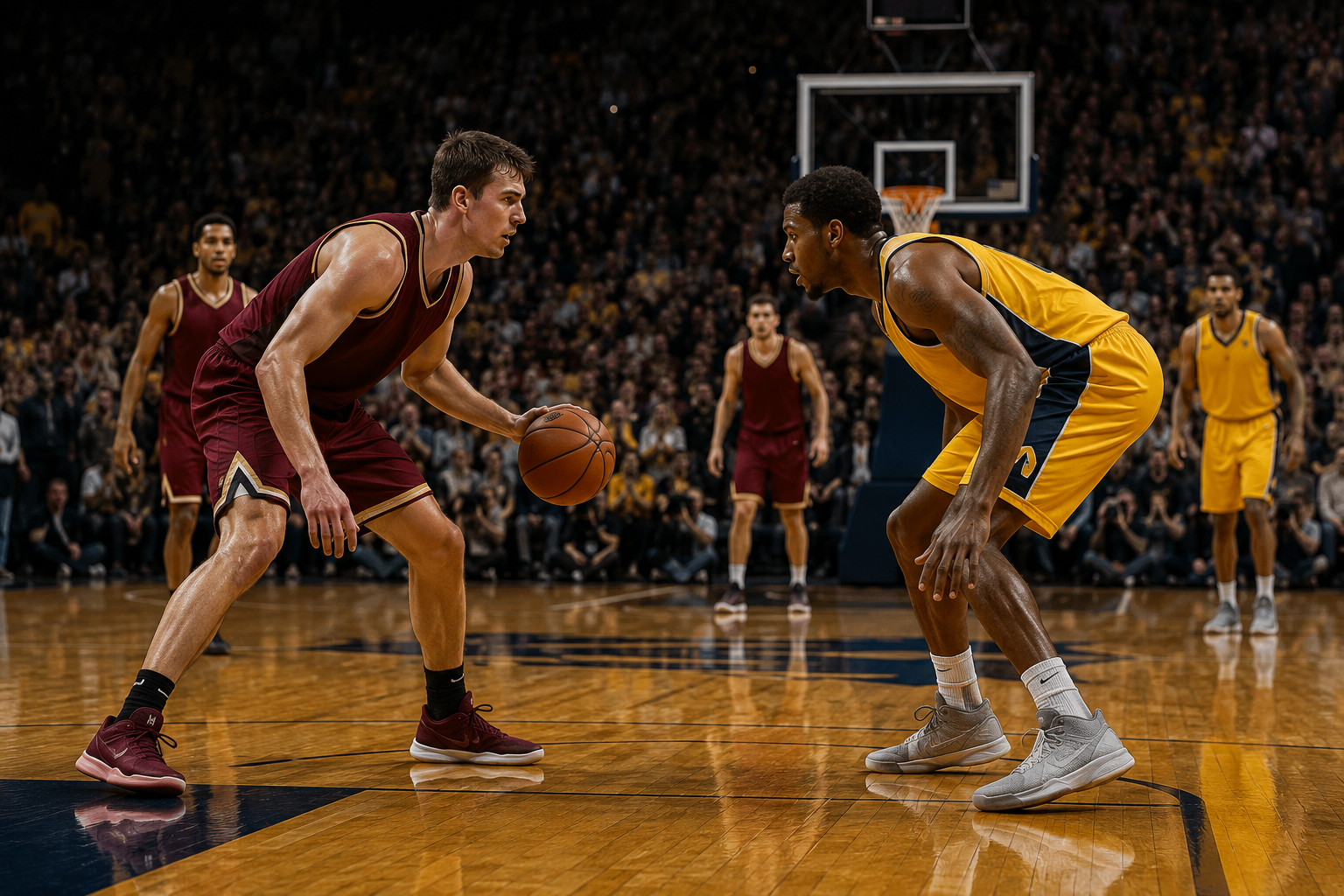
The arena lights burn brighter. The crowd rises as one. Every possession feels heavier, every whistle becomes controversial, and every shot carries the weight of history.
Basketball reaches its most dramatic form when two familiar enemies meet. These games are rarely decided by talent alone. Pride, revenge, geography, championships, and generations of unforgettable moments all enter the contest.
From legendary NBA battles to emotionally charged college and international clashes, these rivalries have transformed ordinary games into sporting theater.
Boston Celtics vs. Los Angeles Lakers: The Championship Standard
No discussion of basketball conflict can begin anywhere else.
The Boston Celtics and Los Angeles Lakers represent two different basketball worlds. Boston built its identity around tradition, defense, discipline, and banners hanging from the rafters. Los Angeles became the home of glamour, superstars, fast breaks, and championship spectacle.
Their rivalry exploded during the 1960s, when Bill Russell’s Celtics repeatedly stood between the Lakers and the championship. Los Angeles possessed extraordinary scorers, but Boston consistently found a way to survive the final battle.
Then came the 1980s.
Larry Bird carried Boston’s working-class intensity, while Magic Johnson directed the dazzling Showtime Lakers. Their contrasting personalities and playing styles turned every meeting into a national event. Bird attacked with calculated toughness. Magic responded with creativity, speed, and a smile that concealed his competitive fire.
Their Finals confrontations helped push the NBA into a new era of global popularity. Decades later, Kobe Bryant and Paul Pierce renewed the feud, proving that the rivalry belonged to the franchises rather than one generation.
Among all historic basketball rivalries, Celtics versus Lakers remains the ultimate championship confrontation. It is not simply East against West. It is legacy against legacy.
Chicago Bulls vs. Detroit Pistons: The Battle for Control
Before Michael Jordan could rule the NBA, he had to survive Detroit.
The Pistons of the late 1980s were physical, fearless, and unapologetically aggressive. Known as the “Bad Boys,” they understood that defeating Chicago required more than conventional defense. Jordan had to be challenged on every drive, surrounded in the paint, and forced to earn every point through contact.
Detroit’s defensive approach frustrated the Bulls repeatedly. Isiah Thomas, Joe Dumars, Bill Laimbeer, and Dennis Rodman played with the confidence of a team that knew it could disturb Chicago’s rhythm.
For Jordan, each defeat became fuel.
Chicago grew stronger, more disciplined, and more prepared for the physical punishment. When the Bulls finally swept Detroit in the 1991 Eastern Conference Finals, it felt like a transfer of power.
The Pistons walked off the court before the final buzzer, adding another controversial chapter to one of the fiercest basketball team rivalries ever witnessed.
Chicago did not simply win a playoff series. The Bulls broke through the wall that had blocked their path to greatness.
New York Knicks vs. Miami Heat: Every Possession Became Personal
The late-1990s rivalry between the New York Knicks and Miami Heat was basketball played at the edge of confrontation.
These teams shared defensive philosophies, familiar personnel, and very little affection for one another. Miami coach Pat Riley had previously led the Knicks, adding a deeply personal layer to the competition.
The games were slow, physical, and emotionally exhausting. Easy baskets disappeared. Players fought for rebounding position as if the entire season depended on one loose ball.
Patrick Ewing carried New York’s hopes, while Alonzo Mourning became the defensive heartbeat of Miami. Around them stood players who embraced pressure and refused to retreat.
Four consecutive postseason meetings from 1997 through 2000 produced suspensions, altercations, dramatic finishes, and unforgettable tension. The margins were impossibly narrow.
This was one of the greatest sports feuds because it never needed constant scoring to create excitement. A hard screen, a disputed foul, or a stare across the court could ignite the entire arena.
When New York and Miami met, basketball became a test of nerve.
Golden State Warriors vs. Cleveland Cavaliers: Four Finals, One Defining Era
For four consecutive seasons, the NBA Finals belonged to the Golden State Warriors and Cleveland Cavaliers.
Golden State changed the geometry of basketball. Stephen Curry and Klay Thompson stretched defenses beyond their traditional limits, while Draymond Green gave the Warriors versatility, emotion, and defensive intelligence.
Cleveland answered with LeBron James.
The rivalry reached its emotional peak in 2016. Golden State entered the Finals after a historic regular season and moved within one victory of another championship. Cleveland then produced a comeback that seemed almost impossible.
Down three games to one, the Cavaliers refused to surrender.
LeBron’s chase-down block in Game 7 became an enduring image of championship defense. Kyrie Irving followed with a decisive three-pointer over Curry, and Cleveland completed its comeback to capture the city’s first NBA championship.
Kevin Durant’s arrival in Golden State shifted the balance again, making the Warriors even more powerful. Yet the annual rematches kept the entire basketball world watching.
Few legendary NBA showdowns have compressed so much star power, tactical evolution, and emotional drama into such a short period.
San Antonio Spurs vs. Phoenix Suns: Precision Against Pace
The San Antonio Spurs and Phoenix Suns produced a rivalry shaped by contrasting basketball philosophies.
San Antonio operated with patience and precision. Tim Duncan anchored the interior, Tony Parker attacked gaps, and Manu Ginóbili introduced controlled chaos. Under Gregg Popovich, the Spurs rarely allowed emotion to overpower execution.
Phoenix played at a breathtaking speed.
Steve Nash controlled an offense designed to attack before defenses could settle. Amar’e Stoudemire finished above the rim, while shooters spread across the floor and forced opponents into uncomfortable decisions.
Their playoff meetings were filled with tactical adjustments, physical confrontations, and disputed moments. Phoenix often appeared capable of changing the direction of the league, but San Antonio repeatedly stood in the way.
That tension turned their games into a classic struggle between innovation and structure. Fans following famous basketball feuds still debate whether Phoenix’s revolutionary offense might have achieved more without the Spurs blocking its championship path.
The scoreboard recorded wins and losses. The rivalry represented something larger: a fight over how winning basketball should be played.
Duke vs. North Carolina: College Basketball’s Loudest Night
Only a short distance separates Duke University and the University of North Carolina. On game night, however, they seem like opposite ends of the basketball universe.
The rivalry combines geography, tradition, recruiting competition, contrasting identities, and enormous national attention. Future NBA stars have entered these games and discovered that reputation offers no protection.
Cameron Indoor Stadium becomes a wall of noise when North Carolina arrives. The atmosphere in Chapel Hill is equally intense when Duke steps onto the floor.
Records often become irrelevant.
An underdog can overturn an entire season with one fearless performance. A missed free throw can remain painful for years. A late three-pointer can turn a college player into a permanent part of rivalry history.
The conflict reached another level when the teams met in the NCAA tournament for the first time in 2022. North Carolina defeated Duke in the Final Four, ending Mike Krzyzewski’s coaching career in the most dramatic setting imaginable.
Among the most intense basketball matchups, Duke versus North Carolina proves that professional contracts are not required to create professional-level pressure.
Real Madrid vs. Barcelona: El Clásico on the Hardwood
The rivalry between Real Madrid and Barcelona extends far beyond football.
Their basketball teams carry the same cultural weight, regional pride, and demand for victory. Every meeting becomes another chapter in a contest between two institutions that expect to compete for every major trophy.
Both clubs have attracted elite domestic and international players. Their battles in Spain’s top competition, domestic cups, and the EuroLeague frequently feature sophisticated tactics and remarkable individual skill.
The intensity is immediate.
A routine possession can trigger deafening whistles. A fast break becomes a declaration of superiority. A victory can shape league standings while also delivering emotional satisfaction to millions of supporters.
Real Madrid and Barcelona show why international basketball rivalries can be just as fierce as anything found in the NBA. Their rivalry is powered by history that extends beyond the court, making every game feel connected to a much larger identity.
Olympiacos vs. Panathinaikos: The Derby of Eternal Enemies
In Greece, Olympiacos and Panathinaikos contest one of basketball’s most intimidating derbies.
Panathinaikos represents Athens, while Olympiacos is rooted in the port city of Piraeus. Their supporters bring relentless noise, giant banners, coordinated chants, and an atmosphere capable of overwhelming unprepared visitors.
The rivalry has decided domestic championships and influenced major European campaigns. Players are expected to understand immediately that this is not a normal fixture.
Momentum can change within seconds.
One defensive stop sends the crowd into an eruption. One controversial call creates fury. One clutch basket can elevate a player into club folklore.
The passion occasionally crosses healthy boundaries, but the sporting intensity remains undeniable. Few arenas communicate pressure as vividly as a packed Greek derby, where silence never arrives until the final result is secure.
Manila Clásico: Barangay Ginebra vs. Magnolia
Philippine basketball has its own grand rivalry: Barangay Ginebra against Magnolia.
Often called the Manila Clásico, the matchup brings together two of the Philippine Basketball Association’s most recognizable teams. Their shared corporate history has never reduced the competitive hostility. Instead, familiarity has made the games even more personal.
Ginebra is famous for its enormous and passionate following. The team’s identity is connected to resilience, dramatic comebacks, and the spirit of never surrendering.
Magnolia brings its own championship tradition, disciplined approach, and loyal supporters. When these teams meet, the arena becomes divided by color, chants, and generations of family allegiance.
The quality of the contest matters, but emotion defines the occasion. Players dive for loose balls with playoff urgency even during the regular season. Every scoring run brings a thunderous response from one side of the building.
For fans exploring classic basketball rivalry stories, Manila Clásico deserves a prominent place. It captures the special relationship between basketball and Filipino culture, where teams become part of personal and family identity.
Why Great Basketball Rivalries Never Truly End
A rivalry survives because victories are remembered and defeats are inherited.
Players retire. Coaches leave. Arenas change names. Yet supporters continue carrying the emotional record from one generation to the next.
The greatest rivalries also need contrast. One team may represent glamour while another represents tradition. One may rely on speed while the other embraces defense. One may be the established champion while the other fights to overthrow the throne.
Most importantly, both teams must be capable of causing genuine pain.
Without meaningful defeat, there is no lasting feud. Without a dangerous opponent, there is no heroic victory. Rivals define one another by demanding a higher level of courage, discipline, and performance.
That is why these games feel different before the opening tip. The players know. The coaches know. The crowd certainly knows.
The ball rises into the air, the noise crashes down, and history waits beneath the basket. In that moment, there is no ordinary season and no ordinary game.
There are only two teams, one court, and a final score that will never be forgotten.