

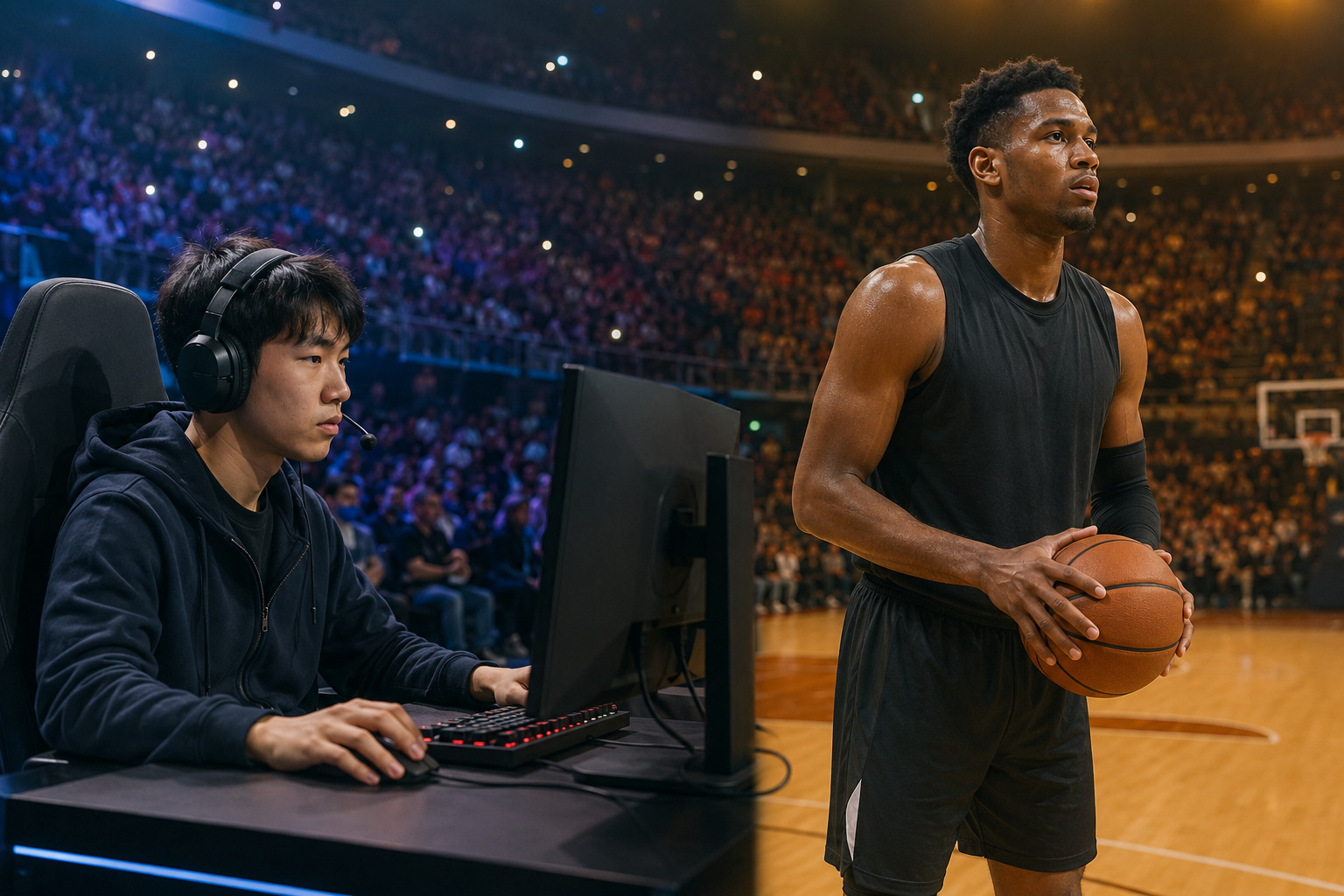
Stadium lights once defined the peak of global competition. Today, championship battles also unfold inside digital arenas, where elite players command keyboards, controllers, and massive international audiences.
The debate surrounding esports vs traditional sports is no longer about whether competitive gaming deserves attention. Both industries now produce professional athletes, passionate fan communities, high-pressure tournaments, and valuable entertainment products.
Their differences remain significant, particularly in training methods and physical demands. Yet their growing similarities suggest that the future of global athletic competition may be more connected than divided.
Esports vs Traditional Sports in the Modern Era
Traditional sports are built around established physical disciplines. Football, basketball, athletics, tennis, and combat sports test speed, strength, coordination, endurance, and tactical awareness.
Esports measures excellence differently. Professional players compete through strategic decision-making, mechanical precision, reaction speed, communication, and detailed knowledge of a digital environment.
This contrast does not make one format inherently superior. It shows that elite competition can test the human body and mind through different systems.
Modern audiences increasingly recognize this distinction. Fans can appreciate a striker’s movement, a sprinter’s acceleration, or a basketball player’s court vision while also admiring the accuracy and split-second judgment of an esports professional.
The expanding world of global sports competition now includes physical stadiums, virtual arenas, and hybrid events designed for digitally connected audiences.
How Their Global Viewership Compares
Traditional Sports Still Command Monumental Audiences
Traditional sports benefit from history, cultural identity, and deeply rooted community traditions. International football tournaments, major basketball finals, and the Olympic Games can unite viewers across generations.
These events are often connected to national pride. Families and communities may support the same teams for decades, creating emotional loyalty that is difficult to reproduce quickly.
Television remains important, but streaming services, mobile apps, and social media have transformed how these competitions reach fans. Viewers now expect highlights, statistics, commentary, and live reactions alongside the main broadcast.
Esports Was Built for Digital Distribution
Esports developed within a streaming-first environment. Its audience is comfortable watching live competitions on computers and mobile devices while participating through chat, social media, and online communities.
This interactive culture makes esports viewing feel immediate. Spectators can follow individual players, watch practice streams, discuss tactical decisions, and engage with tournaments without being physically present.
The future of competitive gaming will be influenced heavily by this accessibility. A major esports event can reach viewers across continents without relying entirely on conventional television networks.
Short-form content also gives competitive gaming an advantage among younger audiences. Dramatic plays can be clipped, shared, analyzed, and turned into global conversations within minutes.
Viewership Is Becoming More Personalized
Traditional broadcasting generally asks viewers to follow a scheduled program. Esports platforms allow fans to select different commentators, player perspectives, languages, and community streams.
Traditional sports are gradually adopting similar features. Alternative broadcasts, tactical camera angles, real-time data, and creator-led commentary are becoming more common.
This convergence suggests that the main competition may not be between sports and esports. It may be between organizations that understand digital audiences and those that continue relying on outdated viewing habits.
Comparing Professional Training Methods
Training in Traditional Sports
Traditional athletes build their routines around physical conditioning and technical repetition. A footballer may combine endurance training, tactical drills, strength work, recovery sessions, and match analysis.
Nutrition, sleep, injury prevention, and rehabilitation are essential components of the process. Coaches must balance workload carefully because excessive training can reduce performance or cause injury.
Team athletes also spend significant time studying formations, rehearsing set plays, and developing communication. Physical ability matters, but it must operate within an organized tactical system.
This combination of conditioning and strategy defines the highest levels of professional athletic competition.
Training in Professional Esports
Elite esports players may practice for many hours each day. Their routines often include mechanical drills, ranked matches, team scrimmages, replay reviews, and strategic preparation.
Repetition helps players improve accuracy, timing, positioning, and decision-making. Teams also analyze opponents to identify predictable patterns, preferred tactics, and weaknesses under pressure.
Communication training is equally important. In team-based games, players must exchange information quickly without distracting one another or overloading the communication channel.
Professional organizations increasingly recognize that endless screen time is not automatically productive. Structured sessions, scheduled breaks, physical exercise, and sleep management can produce better results than uncontrolled practice.
A sustainable competitive gaming training routine must protect both performance and long-term health.
Physical Demands Are Different, Not Absent
Traditional Athletes Face Visible Physical Stress
The physical demands of traditional sports are easy to observe. Athletes run, jump, collide, lift, throw, and change direction at high speed.
Their bodies absorb repeated impact throughout training and competition. Muscle strains, ligament injuries, fractures, and fatigue can affect careers and require extensive rehabilitation.
Different sports demand different physical qualities. Marathon runners depend on cardiovascular endurance, weightlifters require explosive strength, and basketball players combine power, agility, coordination, and repeated sprinting.
Esports Players Experience Less Obvious Strain
Esports does not normally require full-body exertion at the same level. However, professional players face their own physical challenges.
Long practice sessions can create strain in the wrists, hands, neck, shoulders, and lower back. Poor posture and insufficient movement may contribute to discomfort, reduced mobility, and recurring injuries.
Visual fatigue is another concern. Players must maintain focus while processing rapid movements and detailed information on a screen.
The nervous system also works intensely during competition. Heart rate, muscle tension, and stress levels may rise as players make high-stakes decisions in fractions of a second.
For this reason, the comparison between esports vs traditional sports should not reduce physical demand to running distance or calories burned. Each environment places different forms of pressure on the competitor.
Mental Pressure Connects Both Worlds
Elite competition is unforgiving, regardless of the playing surface. Athletes and gamers must perform while being watched, judged, and analyzed by enormous audiences.
A single missed opportunity can decide a championship. Players must control their emotions, recover quickly from mistakes, and continue making rational decisions.
Traditional athletes may experience pressure from spectators inside a stadium. Esports professionals face live audiences as well as constant online commentary that can follow them beyond the event.
Mental preparation has therefore become a serious performance priority. Visualization, breathing exercises, sports psychology, team communication, and controlled routines can help competitors remain composed.
Strong mental performance in sports is not about eliminating pressure. It is about functioning effectively while pressure is present.
Technology Is Changing Athletic Competition
Technology has always shaped sport. Better equipment, medical analysis, video review, performance tracking, and advanced playing surfaces have influenced how athletes train and compete.
Esports takes this relationship further because the competitive environment itself is technological. Game developers can change rules, character abilities, maps, or equipment through software updates.
This creates a unique challenge. Traditional sports usually evolve through gradual rule changes, while an esports title can experience a major strategic transformation almost overnight.
Players must constantly adapt. A successful tactic from one tournament may become ineffective after an update, forcing teams to rebuild their approach.
At the same time, traditional teams increasingly use tools associated with gaming. Simulation software, virtual reality, wearable sensors, and data platforms allow coaches to recreate situations and measure performance more precisely.
The result is a growing overlap between sports technology and esports.
Career Longevity and Athlete Development
Traditional athletes often begin specialized training during childhood or adolescence. Their development may continue through schools, academies, clubs, and professional leagues.
Physical maturity can improve performance, but aging eventually affects speed, recovery, and durability. Career length varies greatly between sports and positions.
Esports players also tend to begin young. Fast reactions and extensive game knowledge can help them reach professional competition early, sometimes before they have developed the emotional skills required to manage fame and pressure.
However, the belief that every esports career must end at a very young age is becoming less convincing. Better coaching, healthier schedules, and improved workload management may allow more players to remain competitive for longer.
Retired competitors from both worlds can transition into coaching, broadcasting, management, analysis, or content creation. Strong development systems should therefore prepare athletes for life beyond active competition.
The Business Models Are Moving Closer Together
Traditional sports generate revenue through broadcasting rights, sponsorships, ticket sales, merchandise, and commercial partnerships.
Esports relies on many of the same sources, but it is also connected to game publishers, digital items, streaming subscriptions, and creator-driven communities.
Both industries compete for attention. Sponsors want access to engaged audiences, while organizers need events that feel important enough to attract viewers repeatedly.
Traditional sports offer heritage and established loyalty. Esports offers digital fluency and direct access to younger communities.
The strongest organizations may combine these advantages. Sports clubs can operate esports divisions, while gaming tournaments can borrow the storytelling, regional identity, and event production techniques developed by established leagues.
Could Esports Enter More Multisport Events?
Esports continues to appear around major international sporting programs, creating debate about its place within the broader athletic world.
Supporters argue that organized gaming demands skill, discipline, teamwork, coaching, and competitive excellence. Critics point to its lower level of full-body physical activity and its dependence on privately owned game titles.
Both arguments raise legitimate questions. Any long-term inclusion model would need transparent qualification systems, stable rules, fair governance, anti-doping standards, and clear competitive integrity.
Game ownership is especially important. Football does not belong to one company, but an esports title generally does. Publishers can determine how a game operates and whether its competitive ecosystem continues.
Solving this structural issue may be essential to the global recognition of esports as athletic competition.
Hybrid Sports Could Create a New Category
The future may not force audiences to choose one side. Hybrid competition could combine physical activity with gaming technology, augmented reality, simulation, or real-time digital scoring.
Virtual cycling already connects physical effort with online environments. Racing simulators can help competitors develop track knowledge and tactical awareness. Mixed-reality systems may eventually create entirely new sports.
These formats could make athletic participation more accessible. People in different locations could compete within shared digital spaces without needing to travel to the same venue.
Technology may also introduce adaptive competition for athletes with disabilities, allowing equipment and digital environments to create fairer opportunities.
Hybrid formats will not replace football, basketball, athletics, or established esports. They will expand the definition of what organized competition can become.
Traditional Sports and Esports Can Grow Together
The esports vs traditional sports debate is often framed as a battle for dominance. In reality, the two sectors can learn from one another.
Esports can adopt stronger health standards, coaching structures, athlete protections, and long-term development programs. Traditional sports can learn from the interactive broadcasts, global online communities, and personalized viewing experiences common in gaming.
Both depend on compelling personalities and meaningful rivalries. Both require rules that audiences understand and competitions they trust.
Most importantly, both transform difficult skills into public drama. The arena may be physical or virtual, but spectators still want to witness preparation, courage, adaptation, and exceptional performance.
The Future of Global Athletic Competition
Traditional sports will remain culturally powerful because they connect physical movement with history, geography, and community identity. Esports will continue expanding because digital competition reflects how younger generations play, communicate, and consume entertainment.
Neither format needs to eliminate the other.
The future of competitive gaming will include healthier players, more professional training systems, improved governance, and increasingly sophisticated broadcasts. Traditional sports will become more digital, interactive, and data-driven.
Global athletic competition is entering an era with more types of athletes, more ways to participate, and more platforms through which fans can experience decisive moments.
The next great champion may cross a finish line, sink a final shot, or execute a perfect play inside a virtual arena. What matters is the same in every case: skill developed through discipline and proven when the pressure reaches its highest point.