

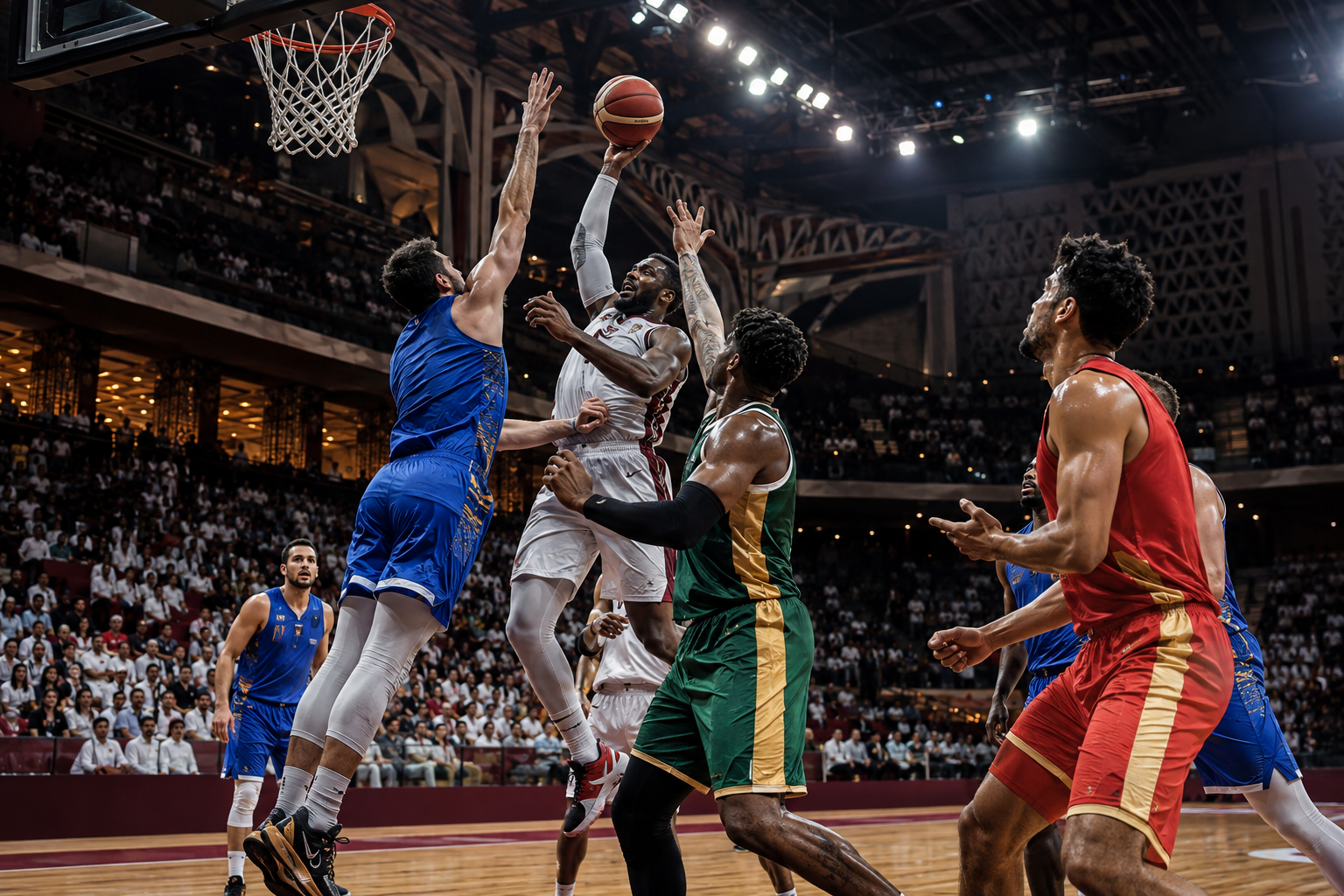
The road to Qatar is entering its decisive phase, with national teams fighting through high-pressure qualifying windows for a place on basketball’s biggest global stage. The FIBA World Cup 2027 schedule runs from August 27 to September 12, 2027, while the qualification race continues until March 2, 2027.
Thirty-two teams will eventually compete in Doha, but only host nation Qatar has an automatic place. Europe, the Americas, Africa, Asia and Oceania must determine the remaining 31 participants through regional campaigns in which every result carries forward and every point differential can influence qualification.
FIBA World Cup 2027 Schedule and Key Dates
The 20th edition of the men’s FIBA Basketball World Cup will take place over 17 days. It begins on August 27 and concludes with the championship game on September 12, 2027. The opening group phase is confirmed for August 27 to September 1. FIBA’s official tournament calendar confirms the overall competition dates.
The confirmed timeline is:
- August 27–September 1, 2027: First group phase
- September 2–12, 2027: Second round, classification games and knockout phase
- September 12, 2027: Championship game
- April 2027: Final tournament draw
The detailed game-by-game schedule—including groups, tip-off times and venue assignments—cannot be finalized until the 32-team field and tournament draw are complete.
Fans following the complete FIBA World Cup 2027 schedule should therefore distinguish between confirmed competition dates and individual fixtures that will be announced closer to the event.
FIBA 2027 Host Nation and Tournament Venues
Qatar will become the first country in the Middle East and North Africa region to stage the men’s Basketball World Cup. Unlike the multi-country format used in 2023, the 2027 competition is designed as a compact, single-destination event centered on Doha.
The four confirmed venues are Lusail Arena, Al Attiyah Arena, Duhail Arena and Al Janoub Arena. FIBA says the venues are approximately 30 minutes apart, potentially allowing supporters to attend more than one game in a day.
Lusail Arena
Lusail Arena is the tournament’s flagship indoor venue and the confirmed setting for the championship game. It has a listed capacity of 15,227 and has previously staged Qatar national-team games and the FIBA West Asia Super League Final 8.
Its size, modern facilities and major-event experience make it the logical home for the most commercially important knockout games.
Al Attiyah Arena
The 8,600-seat Al Attiyah Arena is integrated with the Al Sadd Sports Club complex. It has hosted major international boxing and judo events, as well as Qatar basketball games.
The venue should deliver a more intimate atmosphere than Lusail while still being large enough for high-profile group and second-round matchups.
Duhail Arena
Duhail Arena is the smallest of the four venues, with approximately 5,500 seats. Its stands sit close to the playing floor, creating the type of compressed atmosphere that can transform an ordinary group game into a hostile road environment.
FIBA has confirmed that it will stage group-phase fixtures.
Al Janoub Arena
Al Janoub is the tournament’s most distinctive venue project. Originally built as a football stadium and used during the 2022 FIFA World Cup, it will be converted into an indoor basketball arena with approximately 8,200 seats.
The conversion connects Qatar’s football infrastructure with its next major global sporting event while reducing the need to construct another permanent arena. Venue details were confirmed in FIBA’s official announcement.
Complete FIBA World Cup Qualifier Dates
The global qualification campaign began in November 2025. Most regions use six nine-day windows, although Africa stages its games through five centralized tournament windows.
The principal international basketball tournament dates are:
- Window 1: November 24–December 2, 2025
- Window 2: February 23–March 3, 2026
- Window 3: June 29–July 7, 2026
- Window 4: August 24–September 1, 2026
- Window 5: November 23–December 1, 2026
- Window 6: February 22–March 2, 2027
Each team generally plays two games per window on a home-and-away basis. Africa is the exception, using centralized tournament locations and five competitive windows.
The system creates an important roster-management challenge. NBA and EuroLeague availability can change between windows, forcing coaches to build deeper player pools rather than depending exclusively on their biggest names.
Regional Qualifier Structures and Available Slots
A total of 80 national teams entered the main qualification process: 32 from Europe and 16 apiece from the Americas, Africa, and Asia-Oceania.
The 32 World Cup places are distributed as follows:
- Europe: 12 places
- Americas: 7 places
- Africa: 5 places
- Asia-Oceania: 7 qualifying places
- Qatar: 1 automatic host place
Europe: 12 Places
Europe has the largest qualifying field and the most available berths. Thirty-two teams begin in eight groups of four, playing home-and-away games during the first three windows.
The top three teams in each group advance. Those 24 teams are reorganized into four second-round groups of six, with first-round results carrying over.
Each country then faces the three opponents it has not already played. The top three teams in every second-round group qualify, producing Europe’s 12 World Cup representatives.
This format leaves virtually no room for careless defeats. A loss against another advancing team remains part of the second-round record, making early-window consistency especially valuable.
Americas: 7 Places
The Americas begin with 16 teams divided into four groups of four. The top three from each group advance to two six-team groups.
Results carry forward, and teams play home-and-away games against the three new opponents in their second-round group.
The top three teams from each group qualify automatically. The better fourth-place team receives the seventh and final Americas berth.
Canada, the United States, Brazil, Argentina and the Dominican Republic headline the Americas qualifying race, but roster availability and difficult road environments can quickly disrupt the expected hierarchy.
Asia-Oceania: 7 Places Plus Qatar
Sixteen teams participate in the Asian Qualifiers, including Australia, New Zealand, Japan, China, the Philippines, Iran and host nation Qatar.
The first round consists of four groups of four. The top three in each group advance to two second-round groups of six, with Qatar progressing regardless of its first-round position because it is already qualified.
At the end of the second round, the top three teams in each group and the best fourth-place team qualify alongside Qatar. That produces eight World Cup teams from Asia-Oceania in total.
Australia remains the region’s benchmark, but Japan’s speed, the Philippines’ scoring talent and New Zealand’s physical system make this one of the most intriguing international basketball qualification battles.
Africa: 5 Places
Africa uses a centralized tournament format rather than conventional home-and-away windows. Sixteen teams are divided into four opening groups, with the top three from each progressing.
The remaining 12 teams form two second-round groups of six. Opening-round results are retained, ensuring that performances from the first stage remain relevant.
The top two countries in each second-round group qualify, while the stronger third-place finisher claims Africa’s fifth berth.
South Sudan, Angola, Côte d’Ivoire, Senegal, Egypt, Tunisia and Cape Verde belong in the main contender conversation. Africa’s growing depth means established programs can no longer treat qualification as routine.
Qualified Teams for the 2027 World Cup
As of August 26, 2026, Qatar is the only confirmed participant because of its status as host. No other team had mathematically secured a place before the fourth qualifying window.
Current list of qualified teams for Qatar 2027:
- Qatar — automatic qualification as host nation
The remaining places will be decided during the second-round windows in August 2026, November 2026 and February 2027. Africa concludes through its separate centralized schedule, with its final qualifiers also determined by March 2027.
Tournament Format and Advancement Rules
The World Cup itself is expected to feature 92 games across three main competitive phases.
- The 32 teams are divided into eight first-round groups of four.
- Every team plays three opening-round games.
- The top two teams in each group advance to the second round.
- The bottom two enter classification games for positions 17–32.
- The 16 advancing teams form four second-round groups of four.
- Results against the other advancing team from the original group carry over.
- The top two teams in each second-round group reach the quarterfinals.
- The final eight enter a single-elimination bracket.
- Quarterfinal losers play classification games for fifth through eighth place.
- The finalists compete for the Naismith Trophy on September 12.
This format rewards more than star power. Teams need reliable bench production, adaptable defensive coverages and enough shooting to survive opponents with contrasting styles.
Leading Contenders and Key Players to Watch
Roster projections more than a year before the tournament must remain conditional. NBA workloads, injuries, club commitments and player decisions will influence the final squads.
Still, several national teams already possess championship-level cores.
- United States: Any roster built around elite two-way NBA talent will start among the favorites. Anthony Edwards, Jayson Tatum, Devin Booker and Paolo Banchero represent possible options, but availability will determine the final hierarchy.
- Serbia: Nikola Jokic gives Serbia the tournament’s most influential offensive centerpiece if he commits. His passing forces opponents to defend every cut, screen and weak-side movement.
- France: Victor Wembanyama could become the defining player of Qatar 2027. His combination of rim protection, shooting range and ball-handling offers France a tactical profile no other team can fully reproduce.
- Canada: Shai Gilgeous-Alexander leads an athletic generation capable of switching defensively and attacking from multiple positions. Canada’s key question is whether its strongest possible roster will remain available throughout preparations.
- Germany: The 2023 world champions established an identity built on continuity, size and disciplined execution. Franz Wagner remains central to their transition attack and half-court creation.
- Slovenia: Luka Doncic can control an international game through pace, physicality and passing. Slovenia’s ceiling will depend on the defensive structure and shooting placed around him.
- Australia: The Boomers’ experience, defensive communication and established national-team culture make them a persistent threat in major competitions.
Emerging teams also deserve attention. South Sudan’s athletic development, Japan’s spacing, the Philippines’ offensive talent and several increasingly competitive African programs reflect the global expansion of elite basketball.
For more national team basketball analysis, the most revealing storyline will be how coaches combine NBA creators with experienced FIBA specialists who understand shorter games, tighter spacing and possession-heavy tournament pressure.
International Basketball Trends That Could Define Qatar 2027
The tactical gap between regions continues to narrow. More national teams now feature switchable forwards, mobile centers and guards comfortable creating from high pick-and-roll actions.
Three trends could shape the tournament:
- Bigger playmakers initiating offense from multiple positions
- Increased switching and aggressive defensive rotations
- Higher three-point volume combined with faster transition attacks
Depth may be even more decisive than individual brilliance. The qualifying windows reward large player pools, while the condensed World Cup schedule demands recovery, lineup flexibility and immediate tactical adjustment.
Qatar’s compact venue plan could also reduce travel fatigue. That creates a more controlled environment in which preparation, scouting and execution may carry greater weight than logistical resilience.
The qualification race is already showing how little separates established powers from ambitious challengers. Follow the latest global basketball tournament updates as the field moves toward its final 32 teams—and tell us which national team you are rooting for on the road to Qatar.