

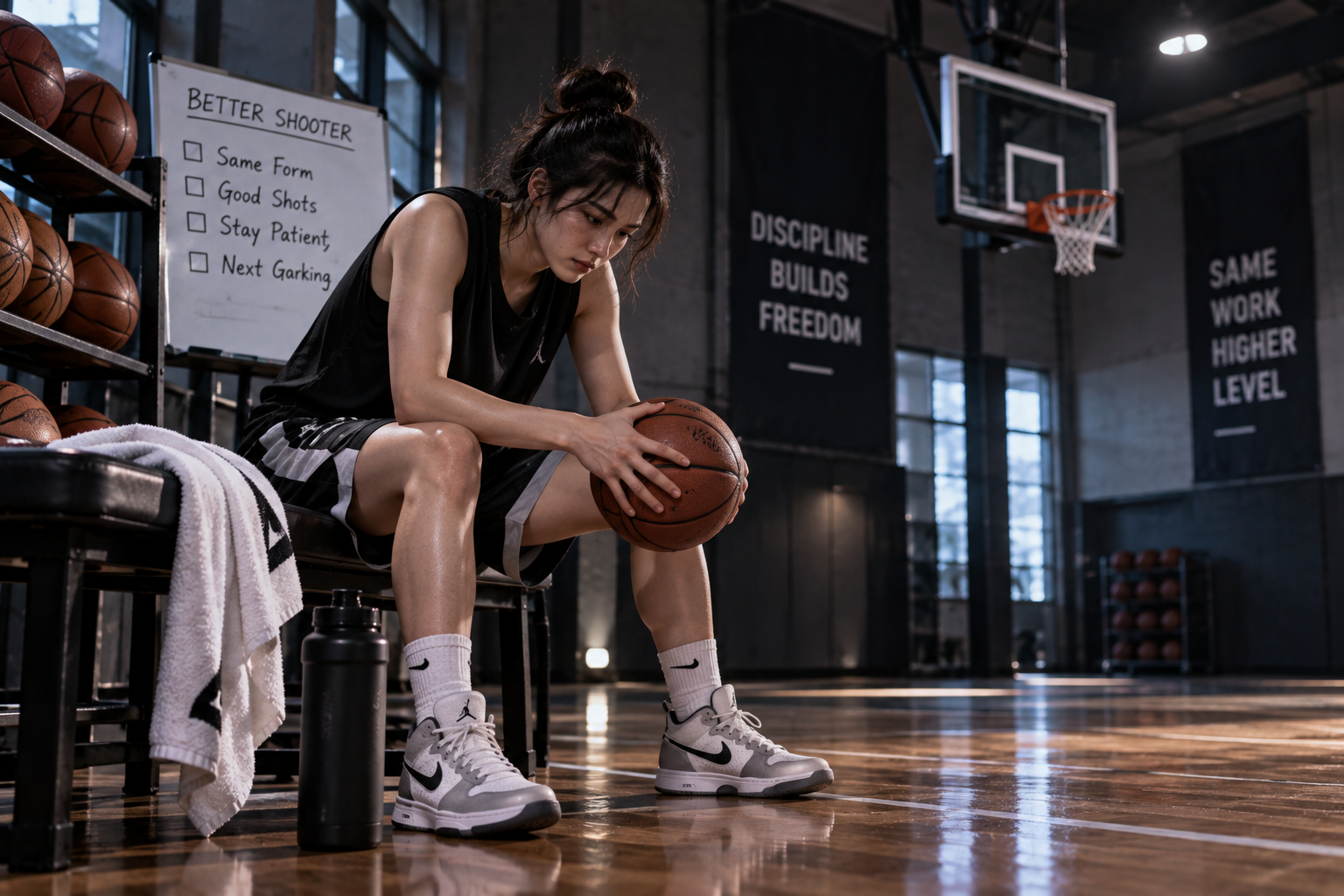
Catch the ball, rise up, release it, and move on. You were not thinking about your elbow, wrist, feet, or follow-through. The shot simply felt natural.
Then the misses started.
One jumper hits the back rim. The next is short. An open three rolls out. Before long, every attempt feels like a test of whether you can still shoot.
A basketball shooting slump can make a player question a skill that seemed completely reliable only days earlier. But learning how to get out of a shooting slump usually does not begin with rebuilding your entire jump shot.
First, you need to understand what actually changed.
A Few Misses Are Not Automatically a Slump
Basketball shooting contains natural variation.
Even excellent shooters miss open shots. A player can execute a good attempt with balanced footwork, clean rhythm, and an appropriate release while still missing.
That matters because players often react too quickly.
After one poor game, they start changing their hand position. After another, they adjust their release point. Soon they are experimenting with several mechanical changes at once.
A short run of misses has now created a completely different problem: the player no longer trusts the movement they spent thousands of repetitions developing.
Look at the Quality of the Shots First
Before blaming mechanics, examine what shots you are actually taking.
Are they the same attempts you normally make?
A shooter might say, “I’m 2-for-10 lately,” but those ten attempts could include contested pull-ups, late-clock threes, transition shots taken off balance, and difficult attempts after several dribbles.
That is different from missing ten clean catch-and-shoot opportunities.
Shot percentage without shot context can be misleading.
Sometimes the fastest way to improve a slump is not fixing the jumper. It is improving the shots being selected.
Open Does Not Always Mean Comfortable
Two shots can both be technically open while demanding very different preparation.
A stationary corner three after a clean pass is not identical to sprinting from the opposite side of the floor, stopping suddenly, locating the rim, catching the ball, and shooting immediately.
Fatigue and movement affect preparation.
So does the direction of the pass.
When reviewing misses, look at what happened before the release. Poor balance often begins several steps before the ball reaches the shooter’s hands.
Check Whether Your Misses Have a Pattern
The direction of a miss can provide useful clues, although no single miss should be overinterpreted.
Are many attempts consistently short?
Are they repeatedly long?
Do they miss left or right?
Or is every miss different?
A consistent pattern may suggest something repeatable is happening. Random misses can point toward inconsistent preparation or rhythm.
The purpose is not to diagnose your entire jump shot from one rebound.
It is to collect information instead of responding emotionally to every attempt.
Fatigue Can Quietly Change a Jump Shot
A shooter may look excellent during an isolated warm-up and struggle later in a game.
That does not necessarily mean the shooting technique disappeared.
Game shooting happens after sprinting, defending, changing direction, absorbing contact, and making decisions.
Tired legs can affect lift and balance. Upper-body tension can increase when the lower body is no longer contributing efficiently.
This is why practice should eventually include shooting under realistic physical demands.
You need more than a jumper that works while completely fresh.
But Do Not Turn Every Shooting Workout Into Conditioning
There is an opposite mistake.
A player wants “game-like” training, so every drill becomes exhausting.
Now every repetition happens with poor balance and declining mechanics.
Useful shooting development includes different levels of intensity.
Some repetitions can emphasize clean technique and touch. Others can reproduce game movement, decision-making, and fatigue.
If every session is performed at maximum exhaustion, it becomes difficult to distinguish skill training from conditioning.
Start Close to the Basket When Rhythm Feels Lost
When a shooter is struggling, immediately taking hundreds of three-pointers can reinforce frustration.
Moving closer can simplify the task.
Short-range shooting allows the player to focus on balance, touch, release, and a relaxed follow-through without needing as much force.
The objective is not to stay under the rim forever.
It is to rebuild a comfortable sequence before gradually moving outward.
A good shooting session does not need to begin where the slump is most frustrating.
Watch for Extra Tension
Shooting slumps often change how players physically approach the shot.
They want the next one to go in so badly that they try to control everything.
Shoulders tighten.
The grip becomes less relaxed.
The release no longer feels fluid.
The player begins aiming the basketball instead of performing a familiar motion.
Trying harder does not always produce better motor execution.
Sometimes the body needs less interference, not more instruction.
Confidence Is Not Pretending Every Shot Will Go In
“Just be confident” is common basketball advice.
It is also incomplete.
Confidence becomes more useful when it is connected to preparation.
You know you have practiced the shot.
You know your feet were ready.
You know the attempt was appropriate.
You accept that a good possession can still end with a miss.
That creates a more stable form of confidence than demanding that every shot must go in.
Separate the Result From the Decision
Imagine you receive the ball completely open from a spot where you regularly shoot well.
You take the shot.
It misses.
Was that necessarily a bad basketball decision?
No.
Now imagine forcing a heavily contested jumper early in the possession and somehow making it.
Was that automatically a good decision?
Again, no.
Players who judge every decision based only on whether the ball entered the basket can develop terrible habits.
During a slump, evaluate both the quality of the decision and the quality of the execution.
The scoreboard only tells you the result.
Do Not Punish Yourself for Missing the “Easy One”
Wide-open misses can feel worse than contested misses.
There is no defender to blame.
That can make the player feel as if an open shot is something they were obligated to make.
But open shots still have probabilities, not guarantees.
The better response is to check whether you were prepared when the opportunity arrived.
If your feet, balance, timing, and shot selection were appropriate, the miss does not automatically require a technical intervention.
Take the information and continue playing.
Avoid Changing Five Things at Once
A player misses short and decides to jump higher.
Then a shot misses left, so they change their hand position.
The next one is long, so they lower the release.
Within ten minutes, their jump shot has become an experiment.
When addressing mechanics, change one clearly identified variable at a time.
Give that adjustment enough repetitions to evaluate.
Otherwise, you will not know which change helped and which created another inconsistency.
Video Can Reveal What Memory Cannot
How a shot feels and how it looks are not always identical.
A short video from a useful angle can help compare your current movement with footage from periods when you were shooting comfortably.
Look for meaningful differences.
Has your stance changed?
Are you consistently drifting?
Is the ball arriving at a different point before the release?
Are you rushing your preparation?
The objective is not to analyze every centimeter of movement.
Video is most useful when it answers a specific question.
Compare Yourself With Yourself
During a slump, watching an elite shooter’s form can be tempting.
There is value in studying skilled players, but copying someone else’s exact mechanics can create unnecessary confusion.
Body proportions, strength, mobility, preferred footwork, release height, and playing role differ.
A more useful comparison is often your own successful shooting.
If you have footage from a period when your jumper was working, compare your current rhythm with that baseline.
The question is not “How do I shoot exactly like this star?”
It is “What changed in the shot that already worked for me?”
Free Throws Can Expose Rhythm Without Defensive Pressure
Free throws remove many variables.
There is no closeout, catch angle, screen, sprint, or defender affecting the attempt.
That makes them useful for observing basic rhythm and touch.
If free throws still feel comfortable while game threes are struggling, the problem may involve preparation, movement, shot selection, or game context more than the fundamental release.
If even stationary shots suddenly feel unfamiliar, a closer mechanical review may be more useful.
Practice Makes Should Have a Purpose
Players sometimes respond to a slump by deciding to make 500 shots every day.
Volume can help, but only if the repetitions have quality.
Five hundred rushed attempts with inconsistent footwork can reinforce the exact problem you are trying to solve.
Instead, divide the workout.
Begin with controlled close-range makes. Move into normal shooting spots. Add catches from realistic angles. Then introduce movement and game-speed repetitions.
Quality creates the foundation that volume can reinforce.
Track More Than Makes and Misses
A shooting log can become more informative if it includes context.
Record location.
Catch-and-shoot versus off-the-dribble.
Stationary versus movement.
Open versus contested.
Fresh versus fatigued.
You may discover that the “shooting slump” is actually concentrated in one situation.
Perhaps stationary shooting remains strong but percentages collapse after moving left.
That gives practice a specific direction.
Your Role Can Change Your Shooting Numbers
Basketball statistics do not exist independently of team context.
Maybe your role recently changed.
You are taking more attempts late in the clock. You are handling the ball more often. Defenders are closing out harder because scouting has changed.
Your raw shooting percentage might fall even though your underlying skill has not suddenly disappeared.
This is why evaluating performance requires context.
A different shot diet can create different numbers.
Defenders Adjust Too
If you shoot well for several games, opponents may begin treating you differently.
Closeouts become more aggressive.
They deny certain spots.
You receive fewer comfortable catches.
That adjustment is part of competition.
The answer may not be “shoot better despite everything.”
Sometimes the correct basketball response is to attack the closeout, make the extra pass, relocate, or create another advantage.
A shooter’s value is not limited to the number of threes attempted.
Do Not Let the Previous Shot Defend the Next One
One of the strangest defenders in basketball does not wear a jersey.
It is the memory of your previous miss.
You catch the ball open, but instead of reading the current possession, your mind is still thinking about the shot you missed thirty seconds earlier.
That hesitation changes the attempt.
The feet stop.
The defender recovers.
Now the shot that was initially clean becomes rushed.
The previous possession should provide information, not physically control the next one.
Use a Simple Reset Routine
A reset does not need to be dramatic.
After a miss, some players use a short physical or mental cue.
Exhale.
Run back on defense.
Say one simple word internally such as “next.”
Then re-enter the possession.
The purpose is not pretending the miss never happened.
It is preventing one result from occupying attention that the next play requires.
Basketball moves too quickly to replay every mistake while the game continues.
Keep Contributing When the Shot Is Not Falling
A cold shooting night does not remove you from the game.
Defend.
Rebound.
Cut.
Set useful screens.
Move the ball.
Communicate.
Run the floor.
A player who mentally disappears because the jumper is not falling turns one struggling skill into an entire poor performance.
Ironically, contributing elsewhere can also reduce the pressure placed on the next shot.
You stop treating every attempt as proof of whether you deserve to be on the floor.
Know When Mechanical Help Is Actually Needed
Not every slump should simply be ignored.
If a persistent problem continues across practice and games, or if a clear mechanical change has appeared, working with a qualified coach can be useful.
This is especially relevant if pain, injury, or altered mobility has changed the movement.
A coach can observe the entire shooting sequence and help identify whether the issue is technical, physical, contextual, or some combination.
The key is avoiding random self-correction based on frustration.
Fix a real problem, not an imagined one created by three missed shots.
How to Get Out of a Shooting Slump
The process becomes much clearer when you stop treating every miss as the same problem.
Review shot quality first.
Look for patterns in the misses. Consider fatigue, movement, role, and defensive pressure. Return to comfortable short-range repetitions if rhythm feels lost, then progressively rebuild toward realistic game attempts.
Use video when there is a specific mechanical question.
Track shooting by situation rather than only overall percentage.
Most importantly, do not rebuild a functioning jumper every time normal basketball variance produces an ugly stretch.
Sometimes the shot needs adjustment.
Sometimes the decisions need adjustment.
And sometimes you simply need to keep taking good shots.
Conclusion
Learning how to get out of a shooting slump begins by separating frustration from useful information.
A poor stretch can come from shot selection, fatigue, inconsistent preparation, changing defensive pressure, altered team roles, excessive tension, or a genuine mechanical issue. Those problems require different solutions, which is why blindly changing your jump shot after every miss can make the slump worse.
Return to simple, high-quality repetitions. Study the type of shots you are missing. Compare your current movement with your own successful baseline and gradually rebuild toward game-speed situations.
Then allow basketball to remain basketball.
A good shooter will miss.
Sometimes several times in a row.
The goal is not to reach a point where misses never happen. It is to develop a process stable enough that a few misses do not convince you to abandon the shot that made you a shooter in the first place.