

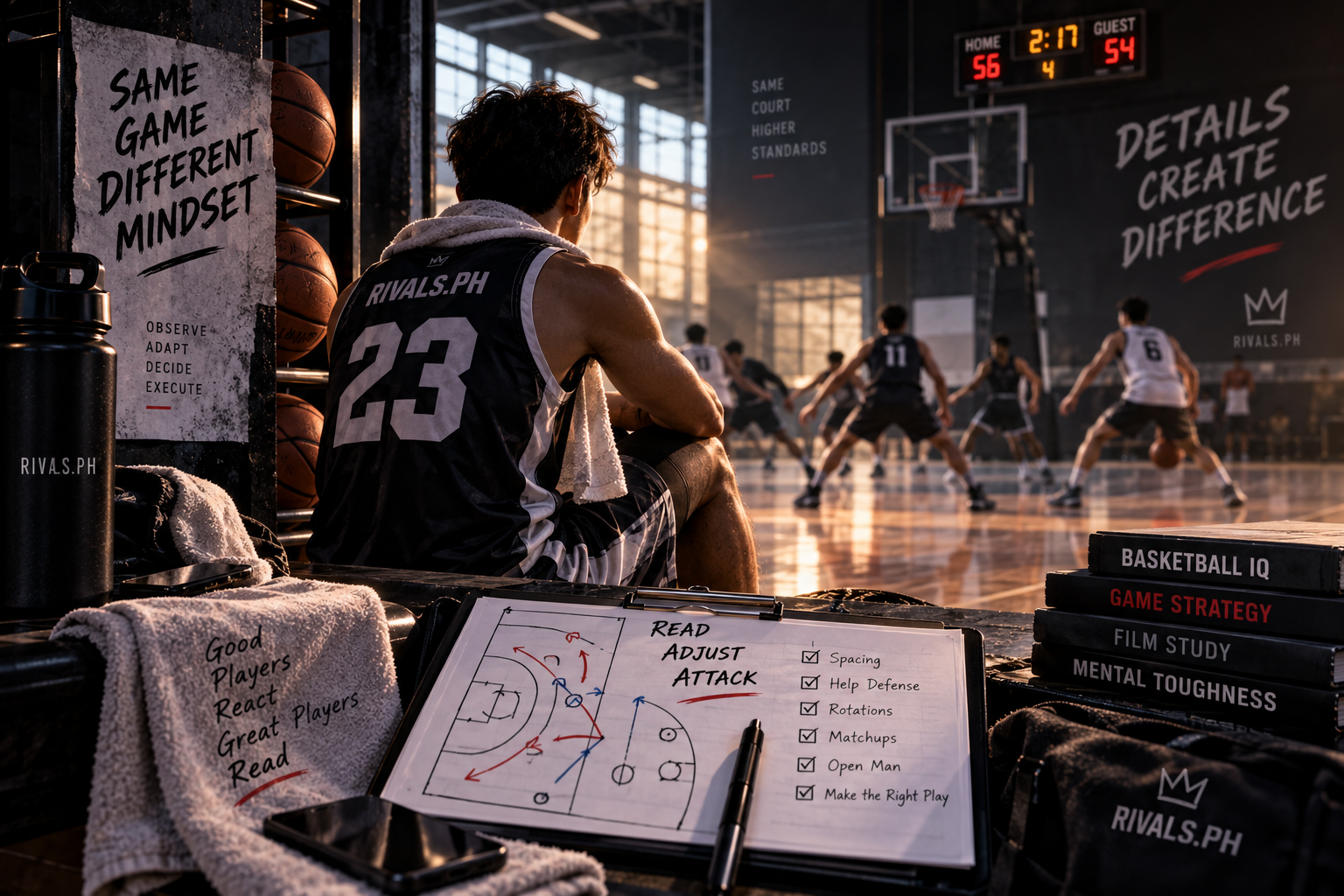
In practice, everything feels simple. You can attack the basket, hit pull-up jumpers, make the extra pass, and finish moves you have repeated hundreds of times.
Then the game starts.
Driving lanes disappear. Help defenders arrive earlier than expected. A pass that looked open becomes a turnover, and suddenly you are reacting to the defense instead of controlling the possession.
The problem may not be your shooting or ball handling. Learning how to read a basketball defense is about recognizing what the defense is giving you before committing to an action. The best offensive players are not simply faster or more skilled. They process the floor earlier.
Good Offense Starts Before You Touch the Ball
Many players begin reading the defense only after receiving a pass.
By then, valuable information has already been missed.
Before the ball reaches you, look at your defender. Are they denying the passing lane? Giving you space? Shading you toward one side? Standing square or already opening their hips?
Then look beyond the first defender.
Where is the nearest help defender? Is the paint crowded? Is someone leaving a weak shooter? Is the corner occupied?
The possession has already started even though you do not have the ball yet.
Stop Looking Only at Your Defender
One-on-one basketball encourages players to focus on the person directly in front of them.
Five-on-five basketball punishes that habit.
You might beat your defender cleanly and still drive directly into two help defenders.
The important question is not only:
Can I beat this defender?
It is:
What happens after I beat this defender?
That second question separates an individual move from a useful offensive decision.
Learn to See the Second Defender
The second defender often determines whether an attack succeeds.
Imagine you are on the wing and your defender is pressuring you aggressively. Beating them toward the baseline looks attractive.
But the opposing center is already positioned near the rim.
Your first defender may actually be encouraging you toward that help.
Instead of seeing pressure as something to escape, ask where the pressure is trying to send you.
Defenders frequently influence offensive players toward areas where support is waiting.
Defensive Positioning Reveals Intentions
A defender rarely stands randomly.
Their feet, hips, shoulders, and distance can provide clues about what they are trying to prevent.
If they are crowding your shooting space, they may be more vulnerable to a drive.
If they are giving you several feet, they may be prioritizing penetration.
If they shade heavily toward your dominant hand, the defense may be trying to force you in the opposite direction.
Do not automatically fight against the defensive positioning.
Sometimes the simplest offensive decision is accepting what the defense has intentionally left open.
Attack Space, Not the Move You Planned
Players often decide what move they want before the possession develops.
“I’m going crossover.”
“I’m going step-back.”
“I’m driving baseline.”
That creates a problem.
The defense may not give you the situation that makes the move useful.
Instead, read the available space first.
If the defender backs up, perhaps you shoot.
If they close aggressively, perhaps you drive.
If help commits, perhaps you pass.
Your skill package should give you answers. It should not become a script you are forced to follow.
The Paint Tells You a Lot About the Possession
Before driving, glance toward the lane.
Is the opposing big protecting the rim?
Has a weak-side defender already moved toward the paint?
Is the lane temporarily empty because the center was pulled outside?
A drive that looks impossible one second can become excellent after a teammate moves a defender.
This is why spacing matters even for players without the ball.
Every offensive position changes the defensive geometry.
Spacing Creates Decisions for the Defense
Good spacing does not guarantee a score.
It creates difficult choices.
If offensive players stand too close together, one defender may be able to influence two players.
If they maintain useful spacing, help defense often requires a more meaningful commitment.
When a defender leaves a shooter to stop penetration, an offensive player becomes available.
When the defender refuses to help, the driver may have a clearer route to the basket.
The offense becomes powerful when it repeatedly forces defenders to choose between two undesirable outcomes.
Watch the Weak Side
Young players often see only the ball side of the floor.
Experienced players learn to monitor the weak side.
A defender standing one pass away behaves differently from someone two passes away. A weak-side player may sink toward the paint to help on a drive while still trying to recover to their assignment.
That movement can create passing windows.
Sometimes the best pass after penetration is not to the nearest teammate.
It is the pass created by the deepest defensive rotation.
Drive to Move the Defense
A drive does not need to end with a layup to be successful.
Penetration can force defenders to collapse.
That creates opportunities elsewhere.
A player who drives while thinking “I must score” may attempt a difficult finish against multiple defenders.
A player who drives while reading reactions sees more options.
Finish if nobody helps.
Pass if help commits.
Pull up if the rim protector retreats.
Keep the dribble alive if nothing clean develops.
The drive becomes a question posed to the defense.
Do Not Pass Just Because Help Appears
Help defense does not automatically mean the pass is open.
A good defender may stunt toward the ball and immediately recover.
If the offensive player panics and throws the pass too early, the defense has manipulated them without fully committing.
Learn the difference between a defender who shows help and one who actually commits to help.
A short hesitation can reveal the difference.
That does not mean holding the ball unnecessarily.
It means reading the defender’s commitment before making the next decision.
Understand the Closeout
Closeouts create some of basketball’s most useful offensive situations.
A defender is moving toward you while trying to regain control.
Their momentum matters.
If the closeout is short and controlled, an immediate drive may not create much advantage.
If the defender flies toward you aggressively, attacking the closeout can force them to change direction.
One hard dribble past an uncontrolled closeout may create more separation than a complicated combination of moves against a balanced defender.
Read momentum before reaching for technique.
The Catch Can Create an Advantage
How you receive the ball affects what happens next.
Catching while completely upright and stationary may allow the defender to recover.
Receiving the ball ready to shoot, pass, or drive forces the defender to respect multiple possibilities.
This is often called being a triple threat.
The concept is simple, but its value is significant.
If your body position makes only one option realistic, the defender’s decision becomes easier.
Good offensive positioning keeps several options believable.
Use the Shot Threat to Create Driving Space
A defender who does not respect your shot can stay farther away and protect the drive.
That changes the geometry of the matchup.
You do not need to become an elite shooter overnight, but developing a credible shooting threat makes other skills easier to use.
The same principle works in reverse.
If defenders know you can consistently attack closeouts, they may approach more carefully.
Offensive skills support one another because each changes how defenders are allowed to position themselves.
Read Pick-and-Roll Coverage Before Making a Move
Ball screens are not simply obstacles placed in front of defenders.
They create a decision-making environment.
The on-ball defender may go over or under the screen.
The screener’s defender may drop toward the paint, switch, show aggressively, hedge, trap, or use another coverage depending on the team’s system.
Your response should change accordingly.
If the defense goes under, space may appear for a shot.
If two defenders commit to the ball, another offensive player may become available.
If the defense switches, a matchup may change.
The correct answer depends on the coverage.
Do Not Rush Immediately After the Screen
Many players use a screen and instantly accelerate without observing what happened.
Sometimes speed is correct.
Other times, a slight change of pace reveals the coverage.
Where is the screener’s defender?
Did your defender recover?
Did the weak-side defender rotate?
Is the roller open?
A moment of controlled patience can make the court easier to read.
Basketball decision-making is not always about moving faster.
Sometimes it is about delaying just long enough to gather better information.
A Switch Changes the Problem
When defenders switch, the original advantage of the screen may disappear.
But another advantage may appear.
A guard could end up defending a larger screener near the basket.
A slower big may now be defending a quicker ball handler on the perimeter.
However, do not automatically force the mismatch.
First ask whether it is actually useful.
A smaller defender may be excellent at fronting the post. A big defender may move well enough to contain a drive.
Attack advantages, not labels.
Recognize When the Defense Is in Zone
Zone defense changes what you should look at.
Instead of each defender following one specific offensive player, defenders are generally responsible for areas and rotations within the team’s scheme.
The mistake is assuming zone means simply passing around the perimeter until someone becomes open.
Good zone offense attacks the structure.
Where are the gaps?
Who protects the high post?
How does the baseline defender react?
What happens when the ball enters the middle?
The goal is to force multiple defenders to make decisions.
The Middle Can Stress a Zone
Many zones become uncomfortable when the ball enters an interior gap.
A player receiving around the high post may be able to shoot, attack, pass to the baseline, or find a cutter.
That forces defenders to collapse inward.
Once the zone contracts, perimeter space can appear.
The exact solution depends on the defensive structure, but the general principle remains useful:
Do not only move the ball around the defense.
Find ways to make the defense move inward, outward, and across multiple responsibilities.
Ball Movement Is Valuable When It Changes the Defense
Passing quickly looks good.
But passing without purpose can become empty movement.
The ball should ideally create a defensive reaction.
A pass can force a closeout.
A reversal can move help defenders.
An interior touch can collapse the paint.
A skip pass can punish an overloaded side.
Do not count passes.
Watch what the passes make defenders do.
Use Ball Reversals to Change Driving Lanes
A side of the floor can become crowded after several seconds of offense.
Defenders settle into help positions.
Passing the ball back across the court forces the defense to shift.
During that shift, gaps may temporarily appear.
A driving lane that did not exist before the reversal can suddenly open.
This is why attacking immediately after the defense moves can be more effective than repeatedly attacking a defense that is already set.
Cut When Defenders Stop Seeing You
Off-ball defenders are constantly dividing attention between their assignment and the ball.
That creates opportunities.
If your defender turns their head completely toward the ball, a cut may punish the lost vision.
Backdoor cuts are especially useful when defenders overplay passing lanes.
Instead of fighting harder to receive the ball in the expected spot, use their aggression against them.
The defense is telling you what space it has abandoned.
Do Not Cut Just to Stay Busy
Movement is not automatically good offense.
A poorly timed cut can bring your defender into a teammate’s driving lane.
It can destroy spacing.
It can also occupy an area another player was about to attack.
Good off-ball movement has timing and purpose.
Cut because the defense lost vision, a teammate penetrated, an area became open, or the offensive system calls for it.
Sometimes maintaining spacing is more useful than moving.
Watch the Defender Guarding the Corner
Corner defenders frequently face difficult help decisions.
If they rotate toward a drive, the corner may become available.
If they stay attached to the shooter, the rim protector may receive less support.
Understanding this relationship helps ball handlers and off-ball players read the same situation together.
The driver needs to see the help.
The corner player needs to understand when to stay, relocate, or cut according to the team’s principles.
Great offense often comes from several players reading the same defensive movement.
Learn the Difference Between Open and Available
A teammate can appear open but still be a poor passing option.
Perhaps a defender is baiting the passing lane.
Maybe the receiver would catch the ball in a bad position.
Perhaps the pass is too long and gives the defense enough time to recover.
The best offensive players evaluate more than whether someone appears unguarded.
They consider passing angle, distance, defender momentum, and what the receiver can do after the catch.
A useful pass creates the next advantage.
Protect Passing Angles
Turnovers often happen before the pass is thrown.
A player dribbles into a position where passing lanes become narrow.
Then pressure arrives and every teammate suddenly appears covered.
Avoid unnecessarily dribbling into corners or areas where the sideline reduces your options unless the action has a purpose.
The court itself can act like another defender.
Maintaining useful angles gives you more escape routes when pressure arrives.
Defensive Pressure Can Reveal an Opportunity
Aggressive defenses want you to feel rushed.
But aggression usually creates risk for the defense too.
Denying a passing lane can expose a backdoor cut.
Trapping the ball temporarily commits two defenders to one offensive player.
Overhelping toward the paint can leave shooters.
Pressuring far from the basket can create space behind the defender.
Instead of thinking, “They are pressuring us, so we have no space,” ask:
Where did the defense remove a player from in order to create that pressure?
Against a Double Team, Find the Numerical Advantage
When two defenders guard one player, another area of the court contains an offensive advantage.
The challenge is reaching it.
Do not wait until the double team completely traps you.
Recognize it early.
Keep vision.
Create a passing angle.
Move the ball out before the defense closes every exit.
After the pass escapes, the offense should attack while the defense is still rotating rather than allowing all five defenders to reset.
Tempo Can Manipulate Defenders
Playing fast does not mean moving at maximum speed on every possession.
Changing speed is often more difficult to defend than constant speed.
A controlled dribble can make a defender relax.
A sudden acceleration then becomes more effective.
The same applies to team offense.
Sometimes transition is available and should be attacked immediately.
Other times slowing down creates better spacing and forces the defense to reveal its coverage.
Good tempo is situational.
Read Transition Defense Before Attacking the Rim
Fast breaks look chaotic, but decisions still matter.
How many defenders are back?
Who is protecting the basket?
Are the wings filled?
Is someone running directly behind the play?
If one defender must stop the ball and protect the rim simultaneously, the offense can force a difficult choice.
But attacking three settled defenders alone usually removes the numerical advantage.
Transition offense rewards speed combined with awareness.
Use the Rim Protector’s Position
The rim protector is one of the most important defenders to track.
If they step toward the ball early, a teammate near the basket may become available.
If they stay deep, a short pull-up or floater may appear depending on the player’s skill set.
If they are occupied by another offensive threat, the lane may become more accessible.
Do not discover the rim protector only after leaving the floor for a layup.
Know where they are before the final attack.
Fouls Change How Defenders Play
Game context matters.
A defender with four fouls may become less aggressive.
A team in foul trouble may protect the paint differently.
Conversely, late-game situations may produce more physical pressure depending on score and strategy.
Offense should recognize these conditions.
Basketball decisions do not occur in a vacuum.
Score, clock, fouls, timeouts, and personnel all influence what the defense is willing to risk.
Know Who the Defense Wants to Shoot
Defenses make strategic compromises.
They may help aggressively from one player while refusing to leave another.
This does not necessarily mean disrespect.
It may simply reflect percentages, personnel, or game planning.
Notice which defenders are repeatedly helping away from their assignments.
That pattern tells you where the defense believes it can take a risk.
The offense then has to decide whether and how to punish that choice.
Study Tendencies, Not Just Highlights
Film becomes valuable when you stop watching only the ball.
Pause before a possession develops.
Where is the help?
Which direction does the defender shade?
How does the team defend ball screens?
Who tags the roller?
Which player helps from the corner?
Then play the possession and see what happens.
At Rivals PH, improving basketball IQ is less about memorizing every possible play and more about learning which visual clues consistently predict the next defensive action.
Review Your Turnovers Differently
Instead of labeling every turnover as “bad pass” or “lost the ball,” identify the decision error.
Did you miss the help defender?
Did you drive without checking the paint?
Did you pass after the defender had already recovered?
Did you attack a gap that disappeared?
Did you pick up the dribble without an outlet?
This creates more useful feedback.
Technique can be practiced.
But decision-making improves faster when the actual mistake is correctly identified.
Practice Decision-Making, Not Only Moves
Cone drills can improve ball control.
Shooting drills can improve mechanics.
But basketball contains defenders making choices.
Include practice that requires reading.
Small-sided games such as 2-on-2 and 3-on-3 can create repeated decisions with more space to observe what happens.
Advantage-disadvantage drills can also force players to recognize rotations.
The goal is connecting skill execution to information.
A move becomes valuable when you know when to use it.
Simplify What You Read at First
Trying to watch all ten players simultaneously is unrealistic for a developing player.
Start with a simple sequence.
First, read your defender.
Second, locate the nearest help defender.
Third, identify the rim protector.
As that becomes natural, expand your awareness toward weak-side rotations and off-ball positioning.
Court vision develops gradually.
You do not need to consciously analyze everything forever. Repetition eventually makes many reads faster and more automatic.
Great Basketball IQ Often Looks Simple
A player catches the ball.
The defender closes too aggressively.
One dribble attacks the closeout.
Help rotates.
The ball goes to the corner.
Shot.
Nothing looked spectacular.
But four correct reads happened in a few seconds.
This is why intelligent offense can look easier than difficult offense.
The player is not necessarily solving harder situations.
They are recognizing the simple solution before the situation becomes difficult.
Conclusion
Learning how to read a basketball defense changes offense from a collection of memorized moves into a series of decisions.
Start reading before receiving the ball. Look beyond your primary defender. Locate help, understand spacing, watch defensive momentum, recognize screen coverage, and notice what changes after penetration.
Most importantly, stop entering every possession with a predetermined answer.
Sometimes the defense gives you the shot.
Sometimes it gives you the drive.
Sometimes the best play is moving the ball and attacking the next rotation.
The goal is not to force your favorite move to work.
The goal is to recognize what the defense has already made available—and make the correct decision before it has time to take that option away.