
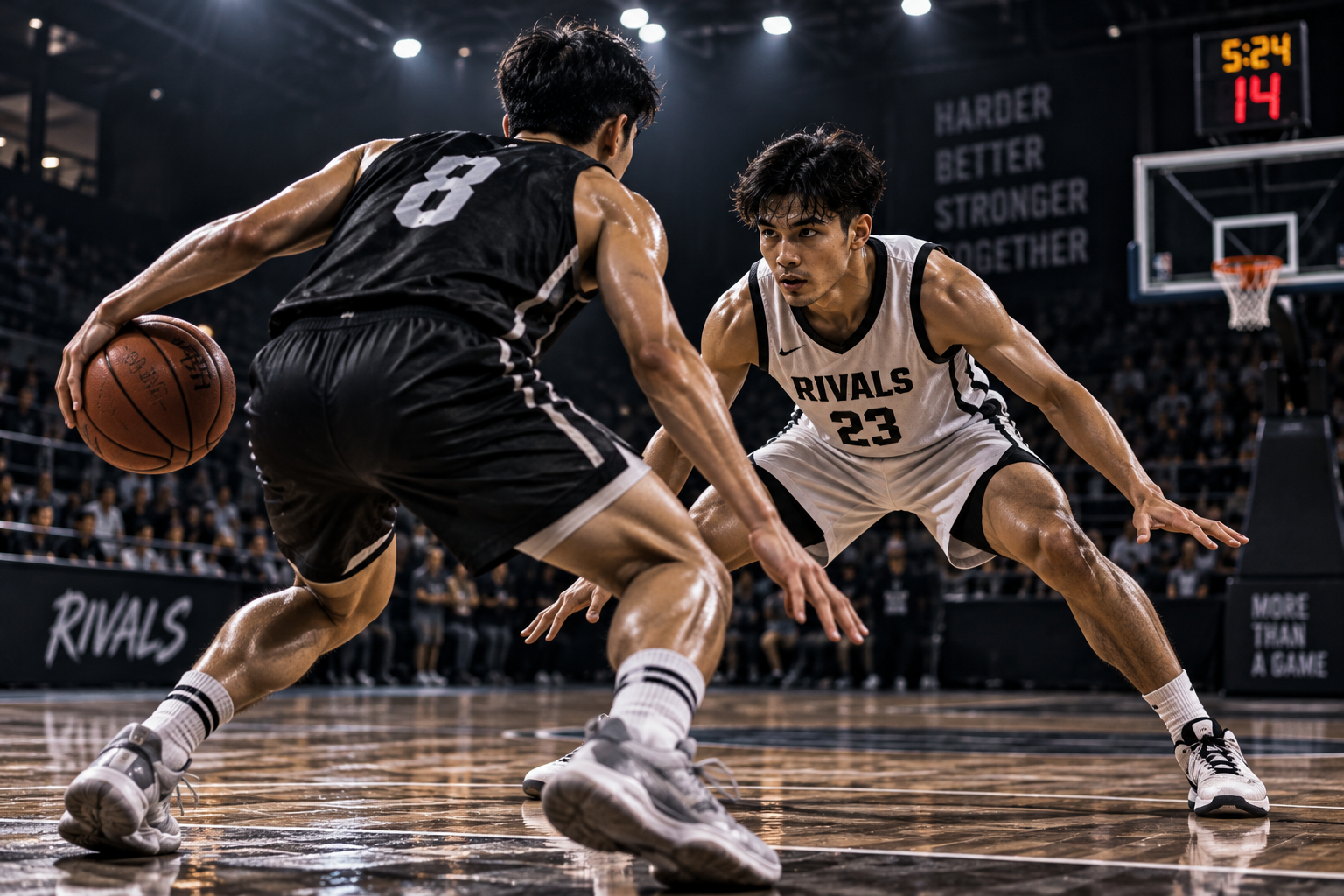
He gets the ball.
You’re ready.
You’re faster.
Probably stronger.
Definitely confident.
He takes one dribble to the right.
You react.
He crosses left.
And suddenly you’re looking at the back of his jersey while he walks toward the rim.
Again.
Next possession?
Same problem.
Now you’re thinking:
How is this happening?
It seems logical that the faster athlete should be the better defender.
Basketball doesn’t work that way.
Speed helps.
Strength helps.
Length helps.
Athleticism helps.
But good defense depends just as much on positioning, anticipation, balance, footwork, discipline, communication, and understanding what the offensive player is trying to accomplish.
Learning how to play better defense in basketball starts with one important realization:
great defenders don’t simply react faster—they make the offensive player’s options smaller before the move even happens.
Defense Starts Before the First Dribble
Watch inexperienced defenders.
They often wait.
Ball handler catches.
Then the defender begins thinking.
Good defenders are already processing information.
Where is the ball?
Where is the basket?
Which hand does the player prefer?
Where is the screen?
Who are the shooters?
How much time is on the clock?
Defense begins before the attacker makes a move.
Athleticism Can Hide Bad Habits
Fast players sometimes survive defensively because they can recover.
Get beaten?
Sprint back.
Lose position?
Jump and contest.
Miss a rotation?
Use speed to recover.
It works.
Until the competition gets better.
Better Offensive Players Punish Mistakes Earlier
Against skilled players, being one step late can be enough.
They don’t need five seconds to recognize the opening.
A small mistake becomes:
a drive,
an open three,
a foul,
or a pass that forces the entire defense to rotate.
That’s why positioning becomes increasingly important as competition improves.
Your Defensive Stance Needs to Let You Move
You’ve probably heard:
“Get low.”
Correct.
But simply squatting as low as possible isn’t the goal.
You need a position from which you can move quickly.
Think Balanced, Not Just Low
Your knees should be bent.
Your hips should be ready.
Your weight should allow movement in either direction.
If you’re leaning too far forward?
You may struggle when the offensive player changes direction.
If you’re standing upright?
Your first lateral movement becomes slower.
Don’t Lock Your Feet Into the Floor
A defensive stance is active.
Small adjustments happen constantly.
You’re responding to:
distance,
angles,
ball position,
and movement.
The stance should make movement easier, not turn you into furniture.
Watch the Hips More Than the Ball
The basketball moves quickly.
Hands can fake.
Eyes can fake.
Shoulders can fake.
The ball can be crossed from side to side.
The hips are harder to lie with.
The Body Eventually Has to Go Somewhere
A player may fake:
right,
left,
right again.
But when they actually attack?
Their center of mass has to move.
Watching the torso and hips can make defensive reads more stable.
Ball Watching Creates Problems
If your eyes become completely attached to the basketball, skilled handlers can manipulate your attention.
Crossovers look bigger.
Fakes become more convincing.
You start reacting to the ball instead of the player.
See the Player and the Environment
Good defense requires broader awareness.
On-ball defender?
Focus heavily on the player you’re guarding.
Off-ball?
You need awareness of both:
your assignment
and
the basketball.
This becomes increasingly important in team defense.
Distance Is One of the Biggest Defensive Decisions
Stand too close?
Easy drive.
Stand too far?
Easy shot.
There is no universal perfect distance.
It depends on the opponent.
Guard Shooters Differently From Non-Shooters
Player is dangerous from three?
You may need to stay closer.
Player struggles from outside but attacks the rim extremely well?
Giving slightly more space may help protect against penetration.
Scouting Changes Defense
Defense isn’t simply:
“guard everybody the same way.”
Ask:
What does this player want?
Then make that option uncomfortable.
Force Players Toward Their Weaker Options
Suppose a player strongly prefers driving right.
If your positioning repeatedly gives them an easy right-hand lane?
You’re helping them.
Instead, influence them toward a less comfortable direction when the defensive scheme allows it.
This Isn’t Always About the Weak Hand
Some teams want to force ball handlers:
toward the sideline,
toward help,
away from the middle,
or into specific areas.
Team strategy matters.
Individual Defense Must Fit Team Defense
You might successfully force a player left.
Great.
Except your teammate expected them right.
Now the defensive rotation breaks.
Communication and scheme matter just as much as individual technique.
Stop Trying to Steal Every Dribble
Ball comes near you.
Your hand immediately attacks.
Miss.
Now you’re off balance.
Ball handler drives past.
This happens constantly.
A Steal Attempt Has a Cost
If you reach without control, you temporarily sacrifice defensive position.
Sometimes the gamble is worth it.
Often it isn’t.
Great Defense Can Be Boring
Stay in front.
Contest.
Force difficult shot.
Box out.
Possession ends.
No highlight.
No dramatic steal.
No crowd reaction.
Still excellent defense.
The Goal Is Not to Look Active
The goal is to make scoring difficult.
Those aren’t always the same thing.
Move Your Feet Before Using Your Hands
When the ball handler attacks, your first solution shouldn’t always be reaching.
Slide.
Turn.
Recover.
Maintain legal guarding position.
Use your body positioning intelligently.
Reaching Often Happens After Losing Position
That’s why players foul.
They get beaten.
Then try to fix the mistake with their hands.
The foul is often the final symptom.
The original mistake happened earlier.
Diagnose the First Mistake
Instead of asking:
“Why did I foul?”
Ask:
Why was I behind the play?
Did I stand too close?
Did I react to a fake?
Was my stance too upright?
Did I open my hips too early?
That’s where improvement begins.
Defensive Slides Aren’t a Race
Traditional defensive drills sometimes make players slide rapidly from cone to cone.
Useful for movement practice.
But real defense isn’t simply sliding as fast as possible.
The Offensive Player Controls the Problem
You have to:
read,
adjust,
accelerate,
stop,
change direction,
and sometimes sprint.
Defense uses multiple movement patterns.
Sometimes You Need to Turn and Run
You’ve been told:
“Never cross your feet.”
That’s useful when teaching basic lateral movement.
But basketball is dynamic.
If an offensive player gets a clear speed advantage?
You may need to turn and sprint to recover.
Recovery Is Different From Sliding
Trying to defensive-slide against a player sprinting toward the basket?
You’re probably losing.
Run.
Get back into position.
Then contest without panicking.
Don’t Automatically Jump on Every Shot Fake
Ball goes up.
You leave the ground.
Offensive player stays down.
Congratulations.
You’re now defending the ceiling.
Stay Disciplined
Shot fakes work because defenders want blocks.
Sometimes the better contest is:
hand up,
body controlled,
feet grounded.
Make the shooter finish over pressure.
Know Who You’re Guarding
A player who rarely shoots?
You can respond differently to their fake.
Elite shooter?
You may need a more aggressive contest.
Again:
context.
Closeouts Are Controlled Emergencies
Your teammate helps.
Ball gets passed to your assignment.
Now you have to cover distance quickly.
This is a closeout.
Sprint First, Control Late
You need speed while covering the open space.
But as you approach the offensive player, you must regain control.
Otherwise they simply attack your momentum.
A Wild Closeout Is an Invitation to Drive
Defender sprints full speed.
Shooter pump fakes.
Defender flies past.
Open lane.
The effort looked impressive.
The result wasn’t.
Arrive Under Control
Shorter steps near the end of the closeout can help you reduce momentum and prepare for the next movement.
Contest without giving away an easy drive.
The Offensive Player Wants You Off Balance
That’s the common theme.
Crossovers.
Hesitations.
Pump fakes.
Step-backs.
Change of pace.
All manipulate balance and timing.
Your Job Is to Stay Patient
The attacker often knows exactly what move they want.
You don’t.
That gives them an informational advantage.
Your discipline helps compensate.
Don’t React to Every Movement Equally
Some movement is dangerous.
Some is decoration.
A dribble sideways 25 feet from the basket isn’t the same threat as a downhill attack into the paint.
Prioritize.
Protect Dangerous Space
Basketball courts aren’t equally valuable everywhere.
Shots near the rim are dangerous.
Open three-pointers can be dangerous.
Certain midrange areas may be less efficient depending on the player and strategy.
Defense should influence where shots occur.
The Paint Changes Everything
When the ball enters the paint, the defense often has to react.
Help comes.
Rotations begin.
Passing lanes appear.
That’s why preventing easy penetration matters so much.
But “Never Get Beaten” Is Unrealistic
Even elite defenders get beaten.
NBA-level offensive players get past NBA-level defenders.
The important question becomes:
what happens next?
Team Defense Exists Because Individual Defense Eventually Breaks
Help defense.
Rotations.
Rim protection.
Recoveries.
Basketball defense is a network.
One defender influences the next.
Help Defense Isn’t Randomly Leaving Your Player
You’re guarding someone away from the ball.
Teammate gets beaten.
You see the drive.
Should you help?
Maybe.
But where are you positioned?
Who are you leaving?
Is that player a dangerous shooter?
Who rotates behind you?
Good Help Has Timing
Help too early?
Easy pass.
Help too late?
Layup.
The window can be small.
Positioning Makes Help Easier
If you’re already in a useful help position, you can react faster.
If you’re standing directly beside your off-ball assignment regardless of ball location?
You may be unable to affect the drive.
See Ball and Player
Classic defensive principle.
Your body position should often allow awareness of both.
Not always perfectly.
But enough that you understand what’s developing.
Don’t Turn Your Back on the Ball for Too Long
Backdoor cuts exist for a reason.
You lose sight of:
ball,
player,
or both.
Offense attacks that moment.
Off-Ball Defense Is Full of Small Decisions
Deny?
Gap?
Help?
Switch?
Trail?
Go under?
Top-lock?
Stay home?
Good defenders constantly adjust.
Communication Makes Those Decisions Faster
“Screen left!”
“Switch!”
“Stay!”
“Help!”
“Cutter!”
“Shot!”
Simple words prevent confusion.
Quiet Defense Is Harder
Imagine trying to navigate traffic where nobody uses:
signals,
lights,
or horns.
That’s team defense without communication.
Talk Before the Problem Arrives
Calling a screen after your teammate hits it?
Not very useful.
Early communication gives teammates time to prepare.
Screens Expose Defensive Technique
Ball handler approaches.
Screener arrives.
Now the defender has multiple problems.
Where is the screen?
Which direction?
What is the team’s coverage?
Learn to Navigate Screens
Sometimes you fight over.
Sometimes go under.
Sometimes switch.
Sometimes the big defender helps temporarily.
The correct choice depends on the scheme and opponent.
Going Under Can Be Dangerous Against Shooters
You give space.
Shooter stops behind screen.
Three-pointer.
Not ideal.
Fighting Over Can Be Dangerous Against Fast Drivers
You chase tightly.
Ball handler turns corner.
Now the big may have to contain penetration.
Again:
tradeoffs.
There Is No Defensive Coverage Without Weakness
Switching creates mismatches.
Dropping can concede certain shots.
Trapping can create four-on-three situations.
Going under can concede jumpers.
Every scheme chooses which problem it prefers.
Good Defense Is Often About Choosing the Least Dangerous Option
Not eliminating every option.
That’s impossible.
Know the Shot Clock
Eight seconds.
Offensive player dribbling far from basket.
Do you need a desperate steal?
Probably not.
Time is already helping you.
The Clock Is a Defender Too
As possession gets late, offensive options shrink.
Don’t rescue the offense with an unnecessary foul.
Foul Discipline Wins Possessions
You defend brilliantly for 20 seconds.
Player takes a difficult fadeaway.
You hit their arm.
Everything before the foul becomes irrelevant.
Contest the Shot, Not the Ego
You don’t need to block everything.
A strong contest may be enough.
Blocks Are Not the Same as Rim Protection
A defender can block several shots while repeatedly leaving position.
Another player may record zero blocks but discourage drives all game.
Which defender had more impact?
The box score doesn’t always answer.
Defensive Statistics Are Incomplete
Steals.
Blocks.
Rebounds.
Useful.
But they don’t fully capture:
containment,
rotations,
communication,
shot deterrence,
or forcing the offense away from preferred actions.
Watch Possessions, Not Only Stats
Did the defender force a difficult shot?
Did they make the ball handler give it up?
Did they rotate correctly?
Did they box out?
These actions matter.
Defense Doesn’t End When the Shot Goes Up
This is one of the most common mistakes.
Shot taken.
Defender watches.
Offensive player grabs rebound.
Second chance.
Find a Body
Box out.
Create contact legally.
Keep the offensive player away from the rebound.
Then pursue the ball.
Great Defense Without a Rebound Is Incomplete
Force difficult shot.
Opponent misses.
Offensive rebound.
Score.
Technically?
You defended twice.
Better to finish the first possession.
Guards Need to Rebound Too
Rebounding isn’t only for centers.
Long shots create long rebounds.
Guards who help finish possessions can dramatically improve team defense.
Transition Defense Starts With Decision-Making
Your team shoots.
Misses.
What happens?
If everyone crashes the offensive glass without balance?
Fast break.
Someone Must Protect the Other End
Team strategy determines who:
rebounds,
gets back,
and stops the ball.
Stop the Ball First
In transition, the ball handler moving downhill is an immediate threat.
Someone needs to slow the advance.
Then Match Up
Transition defense can become chaotic.
Your normal assignment may be somewhere else.
Protect dangerous space first.
Find matchups second.
Don’t Sprint Directly Toward Your Own Player While Ignoring the Ball
If the basket is exposed?
Protect it.
Basketball defense isn’t man-marking for the sake of man-marking.
Angles Beat Speed
This is one of the biggest lessons.
Suppose the offensive player is faster than you.
If you chase directly behind them?
You’ll probably stay behind.
Instead, take an angle toward where they’re going.
Defend the Destination
This principle appears across sports.
You don’t always chase the athlete.
You protect the space they want to enter.
Cut Off the Driving Lane
Position your body between:
ball handler
and
dangerous space.
Now they have to change direction.
Every direction change buys time.
Use the Sideline
The sideline doesn’t move.
It doesn’t get tired.
It doesn’t miss rotations.
When appropriate, defensive positioning can use boundaries to reduce the ball handler’s options.
The Middle of the Floor Often Offers More Choices
Drive middle?
Pass left.
Pass right.
Pull up.
Attack rim.
A sideline can reduce some options.
That’s why many defensive schemes care about directional influence.
Your Feet Should Win Before Your Hands
If your body is correctly positioned, the offensive player has fewer easy paths.
Hands become secondary tools.
Active Hands Still Matter
Hands can:
contest,
deflect passes,
discourage passing lanes,
and bother dribblers.
But they should support good positioning.
Not replace it.
Keep Your Hands Useful
One hand may pressure the ball.
Another may influence passing lanes.
Position changes constantly.
Don’t Slap Down on Every Drive
Ball handlers often expect this.
They protect the ball.
You foul.
Instead, understand when the ball is actually exposed.
Timing Creates Steals
Many steals happen because the defender anticipates:
a pass,
a crossover,
a predictable dribble,
or a careless pickup.
Not because they randomly attack the ball every second.
Study Tendencies
Does the player always cross back after two dribbles?
Do they spin when forced left?
Do they pick up the ball near the baseline?
Patterns create opportunities.
Basketball Players Are Creatures of Habit
Even creative players have preferences.
Favorite hand.
Favorite move.
Favorite spot.
Favorite response to pressure.
The more you recognize them, the less reactive defense becomes.
Watch Film Differently
Don’t only watch:
made shots,
dunks,
or highlights.
Watch the possessions before them.
How did the player create the advantage?
Study the First Move
Maybe the scorer didn’t beat the defender with the final crossover.
Maybe the defender lost balance on the hesitation before it.
That’s the useful moment.
Watch the Defender Too
Where were their feet?
How much space did they give?
Did they open their hips?
Did help arrive?
Film becomes much more useful when you study causes instead of outcomes.
Your Stance Changes With Location
Defending 30 feet from the basket isn’t identical to defending near the rim.
Threats change.
Space changes.
Near the Basket, Small Mistakes Become Expensive
One step?
Layup.
That’s why positioning becomes increasingly important closer to the rim.
On the Perimeter, Space Creates Different Problems
You need to respect:
shooting,
driving,
and passing.
Your positioning must balance all three.
Don’t Defend the Player You Imagine
Defend the player actually in front of you.
Some defenders see:
“guard.”
Then assume:
fast.
Maybe this guard isn’t fast.
Maybe they’re a shooter.
Adjust.
Reputation Can Hurt Defense
You hear:
“This guy is unstoppable.”
Now every fake looks dangerous.
Stay disciplined.
Respect skill without surrendering before the possession starts.
Strong Players Create a Different Challenge
Some attackers don’t need to beat you with speed.
They create contact.
Use shoulders.
Protect the ball.
Finish through defenders.
Strength Helps, but Leverage Matters
A balanced stance and good position can help you absorb contact better than simply trying to be stronger.
Don’t Let Contact Knock You Upright
Once your stance disappears, recovery becomes harder.
Core stability matters.
Defensive Training Should Include Strength
Legs.
Hips.
Core.
Upper body.
Defense is physically demanding.
But Gym Strength Needs Basketball Movement
Heavy squat doesn’t automatically teach:
closeouts,
screen navigation,
or lateral recovery.
Physical training supports skill.
It doesn’t replace it.
Train Deceleration
Everyone loves acceleration.
Fast first step.
Fast sprint.
But defense constantly requires stopping.
You Need to Control Momentum
Closeout.
Stop.
Slide.
Sprint.
Stop again.
Change direction.
Deceleration is a major athletic skill.
Balance Is Defensive Speed
If you’re fast but constantly off balance, your speed isn’t fully usable.
A slightly slower defender who stays balanced may react more effectively.
Reaction Drills Should Include Decisions
Cone drills have value.
But cones don’t:
cross over,
fake,
or shoot.
Include live or reactive drills where another person creates uncertainty.
One-on-One Is Valuable
Especially when the goal isn’t simply scoring.
Set constraints.
For example:
offense gets three dribbles.
Defender must force weak side.
Start from closeout.
Begin from disadvantage.
Constraints isolate skills.
Don’t Measure Defense Only by Whether the Offense Scores
Great shot goes in?
Defense may still have been good.
Terrible shot misses?
Defense may have been bad.
Judge the process.
Ask Better Questions After Each Rep
Did I stay balanced?
Did I force the intended direction?
Was the contest controlled?
Did I recover?
Did I foul?
That’s useful feedback.
Practice Against Different Players
Quick guard.
Strong wing.
Shooter.
Left-handed player.
Crafty ball handler.
Each teaches something different.
One Defensive Style Won’t Solve Every Matchup
You need adaptable principles.
Not one memorized stance.
Fatigue Exposes Defense Quickly
Early game:
low stance.
Active feet.
Communication.
Fourth quarter:
standing upright.
Reaching.
Silent.
Why?
Defense is tiring.
Conditioning Matters
Defensive possessions involve:
short sprints,
slides,
contact,
stops,
jumps,
and repeated accelerations.
Training should reflect the sport.
Mental Fatigue Matters Too
Defense requires concentration.
Lose focus for one second?
Backdoor cut.
Open shooter.
Missed rotation.
Good Defenders Stay Engaged Away From the Ball
That’s difficult because nothing may happen near you for several seconds.
Then suddenly?
Everything does.
Don’t Relax Because Your Player Passed
Passes ball.
Defender:
“Great, my shift is over.”
No.
The player may:
cut,
screen,
relocate,
or receive the ball again.
Follow the Next Action
Offense is continuous.
Defense must be too.
Backdoor Cuts Punish Overplaying
You deny aggressively.
Offensive player recognizes it.
Cuts behind you.
Easy basket.
Pressure needs awareness.
See Space Behind You
The more aggressively you deny, the more vulnerable you may become to back cuts.
Team help influences how much risk you can take.
Communication Makes Aggression Safer
If teammates understand what’s happening, they can help protect the spaces created by pressure.
Defensive Chemistry Takes Time
Five individually talented defenders don’t automatically create a great defense.
They need shared understanding.
Trust Matters
If I help on the drive, will you rotate to my player?
If I switch, will you recognize it?
If I force baseline, will help be there?
Without trust, players hesitate.
Hesitation Creates Half-Decisions
Half-help.
Half-closeout.
Half-switch.
Those are often worse than committing to one clear action.
Teams Need Clear Rules
What happens on:
ball screens,
baseline drives,
post entries,
off-ball screens,
transition?
Clear principles reduce hesitation.
Simple Communication Can Transform Average Defenders
You don’t need five elite stoppers if the team:
talks,
rotates,
helps,
and finishes possessions.
Defense Creates Offense Too
Steal.
Deflection.
Long rebound.
Forced bad shot.
Now the offense can run.
Good defense creates transition opportunities.
But Don’t Chase Steals Just to Start Fast Breaks
The best transition offense often begins with disciplined defense.
Force miss.
Rebound.
Go.
Rebounding Is the Outlet Pass’s Best Friend
No rebound?
No transition.
Finish the possession.
Defense Can Change Momentum Without a Highlight
Three difficult possessions in a row.
Opponent becomes frustrated.
Shot selection worsens.
Crowd gets involved.
Your team gains confidence.
Pressure Accumulates
One possession doesn’t define defense.
Repeated difficulty does.
Great Defenders Make Players Work
Catch farther from preferred spot.
Use extra dribble.
Change direction.
Give ball up.
Receive it again late in clock.
Every small inconvenience adds up.
That’s Defensive Impact
Not necessarily blocking the shot into the fifth row.
Don’t Confuse Aggression With Recklessness
Aggressive defense means:
pressure with purpose.
Reckless defense means:
gambling without protection.
Big difference.
Controlled Pressure Is Harder to Play Against
You feel present.
Close.
Annoying.
But you’re not constantly giving away:
fouls,
driving lanes,
or rotations.
Learn to Defend Without Fouling
Especially late in games.
A player who can’t stay on the court can’t help the defense.
Know Your Foul Situation
Already have four fouls?
Your risk calculation changes.
Basketball intelligence includes understanding game context.
Score Matters Too
Up three with seconds remaining?
Maybe preventing a three is more important than protecting against a two.
Down late?
Maybe aggressive pressure becomes necessary.
Defense Changes With Time and Score
The “correct” decision isn’t always universal.
Situational basketball matters.
End-of-Game Defense Requires Clarity
Switch everything?
Foul intentionally?
Protect three-point line?
No fouls?
Teams need to know before the possession starts.
Confusion Is Expensive
Two defenders think they’re switching.
Actually, neither switches.
Open shot.
That’s why preparation matters.
Watch Great Defenders Away From Highlights
Search full possessions when possible.
You’ll notice things that don’t appear in compilations.
Watch Their Feet
Small adjustments.
Angles.
Recovery.
Watch Their Head
Constant scanning.
Ball.
Player.
Screen.
Help.
Watch Their Mouth
They’re often talking.
Watch What They Don’t Do
No unnecessary reach.
No wild jump.
No panic.
No chasing irrelevant movement.
That restraint is skill.
The Best Defensive Improvement May Be Becoming Less Reactive
Offense wants you to react emotionally.
Big crossover.
Crowd reacts.
You?
Stay balanced.
You Don’t Need to Win Every Fake
You need to win the possession.
Get Comfortable Being Patient
Let the offensive player dribble.
If they aren’t creating an advantage, those dribbles aren’t hurting you.
Make Them Prove the Move Works
Don’t defeat yourself before they do anything.
A Simple Defensive Checklist
Before the possession:
Who am I guarding?
Shooter?
Driver?
Strong hand?
Preferred spot?
During the possession:
Where is the ball?
Where is the help?
Where is the dangerous space?
After the shot:
Where is my box-out?
That’s already a strong foundation.
Try the Three-Possession Challenge
Next time you play, forget about steals.
For three possessions, focus only on:
staying balanced,
keeping the ball in front,
and contesting without fouling.
No gambling.
Then Add Communication
Next three possessions:
call every screen you see.
Talk through every rotation.
Then Add the Finish
Next three:
after every shot, immediately find someone to box out.
Now you’re practicing complete possessions.
Defense Becomes Easier When You Break It Into Jobs
Contain.
Help.
Recover.
Contest.
Rebound.
Transition.
Repeat.
You Don’t Have to Be the Fastest Player
You need to arrive in the right place.
You Don’t Have to Be the Tallest
You need good angles and timing.
You Don’t Need Ten Steals
You need possessions where the offense doesn’t get what it wants.
That’s Why Great Defenders Are So Valuable
They reduce options.
They create uncertainty.
They communicate.
They cover mistakes.
They finish possessions.
And often?
Most of it never appears in the highlight reel.
FAQ
How can I become a better defender in basketball?
Focus on maintaining a balanced stance, improving footwork, understanding positioning, learning opponent tendencies, communicating with teammates, contesting under control, and finishing possessions with rebounds.
Should I watch the ball when playing defense?
Avoid focusing only on the basketball. On-ball defenders can often benefit from watching the ball handler’s torso or hips because these are harder to fake than the ball or hands. Off-ball defenders need awareness of both their assignment and the ball.
Why do I keep getting beaten off the dribble?
Common causes include standing too upright, getting too close to quick players, reacting excessively to fakes, poor balance, opening your hips too early, or reaching instead of moving your feet.
How do I defend a faster basketball player?
Use positioning and angles to reduce open driving lanes, give appropriate space, influence the player toward less dangerous areas, and avoid turning every possession into a straight-line speed contest.
Is getting steals a sign of good defense?
Steals can be valuable, but they don’t tell the entire story. A defender who consistently stays in position, forces difficult shots, communicates, helps correctly, and avoids fouling may have a major impact without recording many steals.
How important is communication on defense?
Communication is essential in team defense. Calling screens, switches, cutters, help situations, and other actions gives teammates more time to react and reduces confusion.
What should I practice to improve basketball defense?
Combine footwork and strength training with live defensive drills, closeouts, one-on-one situations, screen navigation, reaction drills, help-and-recover exercises, and rebounding work.
Conclusion
The offensive player gets the ball.
You’re faster.
You’re stronger.
You’re ready.
Then one crossover later?
You’re behind the play again.
It feels like a speed problem.
But often it isn’t.
Maybe you stood too close.
Maybe your weight shifted before the real move.
Maybe you watched the basketball instead of the player’s body.
Maybe you opened your hips too early.
Maybe you tried to steal a dribble that didn’t need to be stolen.
That’s the frustrating part about defense.
The mistake you notice often isn’t the first mistake.
The foul happens after the bad angle.
The desperate recovery happens after losing balance.
The open three happens after a late rotation.
The offensive rebound happens after everyone watched the shot.
Good defense works in the opposite direction.
Position first.
Balance.
Read.
Communicate.
Contain.
Help.
Recover.
Contest.
Then finish the possession.
None of that requires you to become the fastest player in the gym.
It requires something much more annoying for the offense:
being in the right place over and over again.
Because the hardest defender to attack isn’t always the player with the quickest feet.
Sometimes it’s the player who seems to already know where you’re trying to go.