

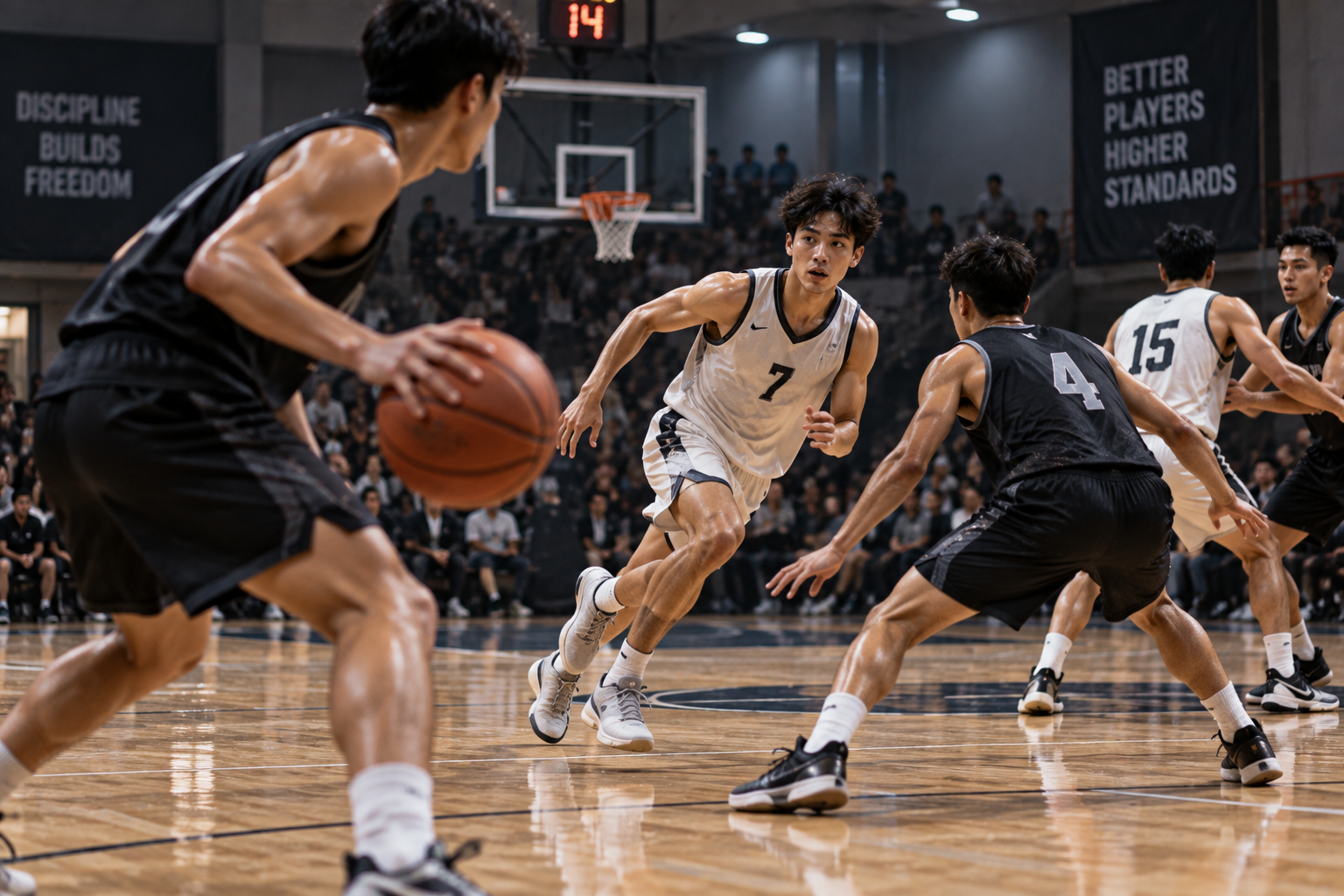
Watch inexperienced basketball players when a teammate receives the ball and something predictable often happens: everyone else stops.
One player dribbles. Four players watch.
At first, this can look harmless. After all, only one player can possess the basketball at a time. But when the other four players become stationary, defenders suddenly have an easy job. Help defense becomes simpler, driving lanes disappear, passing windows shrink, and the possession gradually turns into an isolation.
Learning how to move without the ball in basketball changes that. Great off-ball players do not wait for the game to come to them. Their cuts, spacing, screens, relocations, and timing constantly force defenders to make decisions—even when they never touch the ball.
Basketball Is Mostly Played Without the Ball
A player may spend only a small portion of a game actually holding the basketball. Yet many players train as though possession is the only moment that matters.
They practice dribbling combinations, pull-up jumpers, finishing moves, and isolation sequences. Those skills are valuable, but basketball has five players on the floor. Most of the time, you are participating without controlling the ball.
The question becomes simple: What are you doing during those moments?
Standing still is still an action. Unfortunately, it is usually an action that helps the defense.
Good Spacing Is the Beginning of Off-Ball Movement
Moving without the ball does not mean running constantly.
In fact, random movement can make an offense worse.
Two players cutting into the same area can clog the lane. A player drifting toward the ball handler can bring an extra defender into the action. Someone cutting at the wrong moment may occupy the space a teammate wanted to attack.
Before learning sophisticated cuts, players need to understand spacing.
The floor should feel large to the defense.
When offensive players maintain useful distance from one another, defenders have to cover more ground. Driving lanes become wider, help rotations take longer, and passes have more room to travel.
Sometimes the smartest off-ball decision is simply staying exactly where you are.
Stop Following the Basketball
One common mistake is unconsciously drifting toward the ball.
The point guard moves toward the right wing, so another player also moves right. Then another teammate takes a few steps closer because they want to become available.
Suddenly three offensive players are occupying the same side of the court.
This makes defensive positioning much easier.
Instead of following the basketball, think about the space created by its movement.
If the ball moves one direction, an opportunity may be opening somewhere else.
Good offenses stretch defenses instead of gathering around the ball.
Watch Your Defender, Not Just the Ball
Off-ball players often stare at the basketball.
That means they miss the most useful information available to them: their own defender.
Your defender tells you what opportunity exists.
Are they looking at the ball?
Are they denying the passing lane?
Are they standing several feet away?
Are they helping toward the paint?
Are they positioned above you?
Are they trailing behind you?
Different defensive positions invite different responses.
Off-ball movement becomes much easier when you stop thinking, “Where should I run?” and start asking, “What is my defender giving me?”
When Your Defender Turns Their Head, Cut
One of the simplest basketball principles is also one of the most effective:
If your defender cannot see both you and the ball, move.
A defender watching the ball may temporarily lose awareness of your position. That brief moment can create a backdoor cut, baseline cut, or flash toward open space.
The opportunity may last only a second.
Waiting until the defender looks back is often too late.
This is why good cutters appear almost psychic. They are not necessarily faster than everyone else. They simply recognize the moment when defensive attention shifts elsewhere.
The Backdoor Cut Punishes Overplaying
Suppose a defender is aggressively denying the passing lane.
A young player may respond by fighting harder to get open toward the basketball.
But the defender has already created another opportunity behind them.
Cut toward the basket.
A good backdoor cut forces the defender to immediately turn and recover. If the passer recognizes it, the result can be an easy layup.
Even when the pass never comes, the cut can make the defender less aggressive on the next possession.
That changes how you are guarded.
Cuts Need Commitment
Half-speed cuts rarely accomplish much.
If you decide to cut, make the defense believe you intend to receive the ball.
Accelerate.
Show a target.
Attack useful space.
A lazy cut allows the defender to stay connected while still watching the ball.
A sharp cut demands a reaction.
This does not mean sprinting around continuously. It means creating contrast between patience and sudden movement.
Slow.
Read.
Explode.
That change of pace is often more valuable than pure speed.
But Don’t Stay in the Lane After Cutting
Another common mistake happens after the initial cut.
A player cuts toward the basket, does not receive the pass, and then remains underneath the rim.
Now the paint is crowded.
The ball handler has less space to drive, and another teammate cannot cut into the same area.
A cut should normally have an exit.
If you do not receive the ball, continue through and clear the space. You might exit toward the opposite corner, relocate to the perimeter, or transition into another action depending on the offense.
Think of cutting as moving through space, not permanently occupying it.
Empty Space Is an Invitation
Basketball possessions constantly create temporary empty areas.
A teammate drives and forces help.
A cutter clears the corner.
A screener rolls toward the basket.
A defender rotates.
Suddenly a section of the perimeter becomes vacant.
Good off-ball players recognize these moments and fill the open space.
This is sometimes called replacing or filling.
Instead of standing in the original position because “that’s my spot,” react to how the possession changes.
Positions are starting points.
Spacing is dynamic.
Relocation Makes Shooters Harder to Guard
Imagine you are standing in the corner while your teammate drives toward the basket.
Your defender steps into the paint to help.
Many players simply remain in the corner waiting for the kick-out.
Sometimes that is correct.
But in other situations, relocating a few steps along the three-point line creates a much cleaner passing angle.
Now the recovering defender has to locate you again while changing direction.
This is why elite shooters rarely look completely stationary.
Their movement may be subtle, but they constantly adjust to the ball and the defense.
Drift When the Drive Moves Away
When a teammate attacks along the baseline, a weak-side shooter may drift toward the corner to maintain a useful passing window.
Without that movement, the defender can help toward the rim and potentially recover to the original position.
The drift stretches the recovery distance.
More importantly, it gives the driver somewhere natural to deliver the ball if the defense collapses.
The shooter is not moving simply to “get open.”
They are maintaining a relationship with the driving angle.
Lift When Space Opens Above You
Another common relocation is lifting from the corner toward the wing.
Suppose a teammate drives toward your side and occupies the baseline area.
Remaining deep in the corner may compress the spacing.
Moving upward toward the wing can create separation between you and the drive while opening a clearer kick-out pass.
Again, there is no universal rule that says “always lift.”
The decision depends on where the ball, defender, and other offensive players are located.
That is why understanding spacing matters more than memorizing movements.
Cuts Can Create Shots for Someone Else
One of the biggest misconceptions about off-ball movement is that every cut should result in receiving a pass.
That is not true.
Suppose you cut hard through the paint.
Your defender follows.
A help defender briefly steps toward you.
Now the corner shooter has additional space.
You never touched the ball, but your movement changed two defensive positions.
That may be enough to create the shot.
Basketball impact is not limited to assists and points.
Screens Are Another Form of Off-Ball Playmaking
If your defender is positioned well and no obvious cut exists, you can still influence the possession.
Screen for someone.
An off-ball screen forces defenders to communicate and make decisions.
Will they switch?
Chase?
Go underneath?
Help temporarily?
Every answer creates a possible reaction for the offense.
A player who screens intelligently can create advantages without recording anything in the box score.
Don’t Set Screens Just to Look Busy
Random screens can create the same problems as random cuts.
If you screen someone who was already properly spaced, you may bring two defenders together unnecessarily.
If you screen at the wrong angle, the defender can easily avoid contact.
Before screening, understand what you are trying to accomplish.
Are you freeing a shooter?
Creating a cut?
Forcing a switch?
Opening the paint?
The screen should solve a basketball problem.
Screen Angle Matters
A screen is not simply standing next to a defender.
Your positioning should force the defender to travel around you.
Small changes in angle can completely change the action.
If a teammate wants to curl toward the basket, the screen should support that path. If the goal is to free them toward the perimeter, the angle changes.
Learning screen angles makes an average athlete significantly more useful because it turns positioning into an offensive weapon.
After You Screen, Keep Playing
Many players set a screen and then stop.
The action is not finished.
Depending on how defenders react, you may roll toward the basket, pop into open space, slip before contact, or rescreen.
This creates a second problem for the defense.
The original screen moves one defender.
The next action exploits the movement that just occurred.
Great screeners are difficult to guard because they understand what happens after contact.
Slip When the Defense Anticipates the Screen
If defenders are preparing to switch aggressively, sometimes the best screen is the one you never actually set.
Approach as though you are screening.
Then cut quickly toward the basket before making contact.
This is a slip.
The defense may momentarily prepare for a switch, creating confusion about who should follow the cutter.
Timing matters more than complexity.
A simple slip at the right moment can create a cleaner opportunity than a perfectly executed traditional screen.
Use Cuts to Punish Help Defense
Suppose your teammate beats their defender off the dribble.
A help defender steps toward the lane.
If that help defender is guarding you, their movement has created an opportunity.
Do not remain stationary simply because the play was originally designed for the ball handler.
Cut behind the help.
Now the defender faces a choice: stop the drive or stay with you.
Either decision can create an advantage.
This is one of the core principles of good offense: make one defender responsible for two problems.
Don’t Cut Into Your Teammate’s Driving Lane
The opposite mistake is cutting simply because someone drives.
Imagine your teammate has beaten their defender and finally has a clear path toward the rim.
Then you cut directly through that path.
Your defender comes with you.
The lane disappears.
Your movement looked active, but it actually helped the defense.
Off-ball intelligence requires recognizing when your teammate needs movement and when they need space.
Sometimes the best contribution is getting farther away.
The Weak Side Is Where Many Possessions Are Won
When the ball is on one side of the floor, inexperienced players often mentally disconnect on the opposite side.
But weak-side positioning can determine whether a drive succeeds.
Weak-side players can occupy help defenders, cut behind rotations, screen defenders, relocate for kick-outs, or crash toward rebounding positions.
Defenses are usually strongest around the ball.
That means opportunities often appear away from it.
Use the Baseline Behind Help Defenders
Help defenders naturally turn their attention toward the basketball.
That creates blind spots.
A baseline cutter can travel behind the defense while staying outside the defender’s immediate field of vision.
The passer still needs a safe passing angle, and spacing from teammates matters, but baseline movement can be extremely effective when defenders become overly focused on penetration.
Again, the key is not simply knowing the cut exists.
The key is recognizing when the defender stops seeing you.
Timing Is More Important Than Running Faster
A player can make the correct cut at the wrong time and still ruin the possession.
Cut too early and the passer is not ready.
Cut too late and the window disappears.
Cut while another teammate occupies the lane and you create congestion.
Good off-ball movement is synchronized with the basketball.
Watch when the passer gains control.
Notice when their eyes come up.
Read when the defender turns.
Then move.
A half-second difference can determine whether a cut produces a layup or nothing.
Make Eye Contact With the Passer
Not every cut should receive the ball, but when you are cutting to score, communication helps.
A quick glance between passer and cutter can signal that both players recognize the same opening.
This is especially useful for backdoor actions.
Without that connection, the cutter may disappear toward the rim while the passer is looking elsewhere.
Basketball communication is not always verbal.
Sometimes two players only need to see the same thing at the same moment.
Change Speeds Before You Cut
If you move at maximum speed constantly, defenders adapt to your rhythm.
Instead, use hesitation.
Walk your defender toward one position.
Pause.
Then explode toward another.
A defender reacting to a sudden change of speed has less time to recover.
This is similar to ball handling. A crossover is dangerous not simply because the ball changes direction, but because the offensive player manipulates rhythm.
Off-ball players can manipulate rhythm too.
Change Direction With Purpose
One straight-line cut is easy to anticipate.
If the defender beats you to the spot, react.
Plant.
Change direction.
Use their momentum against them.
For example, you may begin cutting toward the perimeter while the defender trails aggressively, then plant and cut backdoor.
This is why off-ball movement becomes a form of one-on-one basketball even though you never dribble.
You are still trying to move a defender.
Use the Defender’s Position Against Them
If the defender plays above you, the space may be below.
If they sit underneath, the perimeter may become available.
If they deny aggressively, the backdoor opens.
If they help excessively, relocate or cut behind them.
If they switch early, slip or exploit the mismatch.
Instead of forcing a predetermined move, treat defensive positioning as information.
The defense tells you what is available.
Don’t Occupy the Same Line as Another Teammate
Passing lanes matter.
If two offensive players stand directly behind one another relative to the ball, one defender may effectively guard both passing options.
Small changes in position can separate those windows.
Move higher.
Drop toward the corner.
Shift toward the baseline.
The goal is to make every defender responsible for a distinct area.
Good spacing makes five offensive players feel like five separate threats.
Off-Ball Movement Helps Star Players Too
Teams often focus on what should happen when their best scorer has the ball.
But the other four players determine how much defensive attention can be sent toward that scorer.
If everyone stands close together, help defenders can collapse without giving up much.
If teammates maintain spacing, cut behind help, and relocate intelligently, sending a double-team becomes expensive.
The star may create the initial advantage.
Off-ball players decide whether the defense can survive it.
What Should You Do After Passing?
Many players pass and immediately become spectators.
Instead, think:
pass and move.
That does not always mean cutting to the basket.
You could screen away.
Relocate.
Exchange positions.
Cut through.
Replace another player.
The important thing is recognizing that passing the ball does not end your involvement in the possession.
Sometimes the most dangerous moment to move is immediately after your defender relaxes because you no longer have the ball.
The Give-and-Go Still Works for a Reason
The give-and-go is one of basketball’s oldest actions.
Pass the ball.
Immediately cut toward the basket.
Why does something so simple continue to work?
Because defenders naturally shift attention toward the basketball after a pass.
That tiny attention change creates an opportunity for the passer to become a cutter.
Simple actions remain effective when they exploit predictable defensive behavior.
Off-Ball Players Must Understand Their Teammates
Good movement is not only about reading defenders.
You also need to understand the player holding the ball.
A teammate driving with their head down may not be ready to make a difficult backdoor pass.
A skilled passer may recognize cuts immediately.
A post player might benefit from perimeter spacing rather than constant movement.
A strong isolation scorer may need everyone to clear a side.
Basketball IQ includes adjusting your movement to the strengths of your teammates.
Don’t Chase Touches
Players sometimes cut toward the ball simply because they have not touched it recently.
That is an emotional decision, not necessarily a basketball decision.
The goal of a possession is not making sure everyone gets equal dribbles.
If your spacing creates an open lane for a teammate, you contributed.
If your screen creates a switch that leads to a mismatch, you contributed.
If your cut pulls the rim protector away for one second, you contributed.
Off-ball basketball becomes much easier when impact matters more than touches.
How to Practice Off-Ball Movement
Off-ball skills should not exist only in five-on-five games.
They can be trained.
Start with simple partner drills.
Pass, cut, finish.
Pass, screen away, relocate.
Drive, drift, catch, shoot.
Drive, lift, catch.
Add a defender.
Now the offensive player must read denial, help positioning, and defensive vision rather than simply memorizing a route.
Eventually, use small-sided games such as two-on-two and three-on-three.
With fewer players on the floor, every movement becomes easier to see and understand.
Watch Basketball Without Watching the Ball
One of the best learning exercises requires no court.
Watch a game and choose one player who does not have the ball.
Follow them for an entire possession.
Where do they stand?
When do they cut?
When do they deliberately stay still?
How do they react when a teammate drives?
What happens after they screen?
How do they relocate when the ball changes sides?
Suddenly, basketball looks completely different.
You begin seeing the game that exists outside the highlight reel.
A Simple Read for Every Possession
You do not need to memorize dozens of actions immediately.
Start with four questions:
Where is the ball?
Where is my defender?
Where are my teammates?
Where is the useful empty space?
Those four pieces of information can guide most basic off-ball decisions.
If the lane is open and your defender loses vision, cut.
If your teammate is driving, preserve or improve spacing.
If a defender helps away from you, punish the help.
If another player vacates useful space, consider filling it.
The reads become faster with experience.
Great Off-Ball Movement Often Looks Almost Invisible
The best possessions do not always contain dramatic cuts.
Sometimes a shooter moves only three steps.
A screener changes their angle slightly.
A weak-side player waits instead of cutting.
Someone clears the paint at exactly the right moment.
Those small decisions create larger advantages elsewhere.
That is why basketball intelligence can be difficult to appreciate from statistics alone.
A player can improve an offense without touching the ball.
Conclusion
Learning how to move without the ball in basketball begins with understanding that movement is not about staying busy. Every cut, relocation, screen, and spacing decision should create or preserve an advantage.
Watch your defender instead of staring only at the basketball. Cut when defenders lose vision, punish aggressive denial with backdoor movement, relocate when teammates drive, clear the paint after cuts, and use screens to force defensive decisions. Just as importantly, recognize when movement would hurt the possession and simply maintain good spacing.
Once you understand off-ball basketball, possessions stop feeling like periods of waiting between touches.
You are always playing.
And sometimes the player who never touched the basketball is the reason the defense broke down in the first place.