
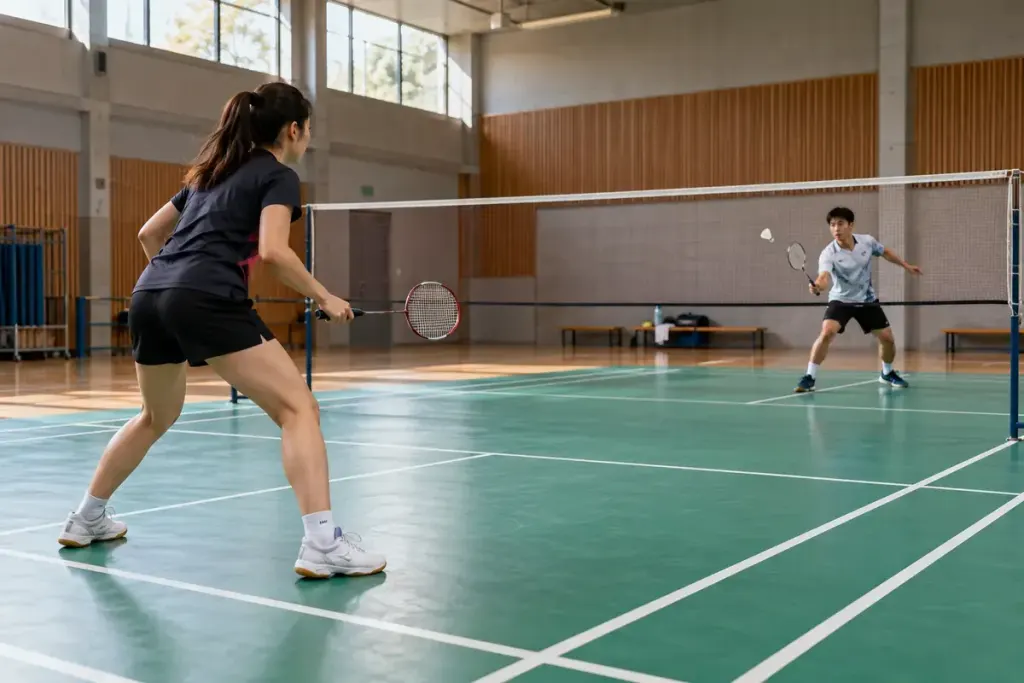
The score is 6–3 and the server moves to the right-hand service court. The important number is the server’s six, not the receiver’s three and not the combined total. In standard badminton service positioning, an even server score goes with the right court and an odd score with the left.
Badminton BC’s rules explanation sets out this relationship. Use the current competition rules for the match you are playing, including any authorised alternative format.
Practise the score before the stroke
In singles, say the server’s score first, choose the appropriate service court and identify the diagonal receiving court. At zero, the score is even. After the server wins a rally, their score changes and the next serve comes from the other service court.
For a fictional sequence, a server at 4–2 serves from the right. If they win the rally, 5–2 means the next serve is from the left. The receiver’s score has not changed, but it was never the number choosing the server’s court.
Do not simplify doubles into random swapping
Doubles also uses the serving side’s score for the appropriate service court, but which partner serves and where players stand follows the service-order rules. Players do not switch places merely because the opposing side scored.
If the order becomes confused, pause and resolve it using the applicable rules or the official. Guessing a new arrangement can preserve the confusion for several more rallies.
For beginners, practise a few imagined scores without hitting a shuttle. Have one person call the score and another point to the serving court. Then add the receiver’s position.
This small routine reduces a common distraction. Once the score and positions are clear, attention can return to making a legal, controlled serve rather than wondering which half of the court belongs to the next point.