
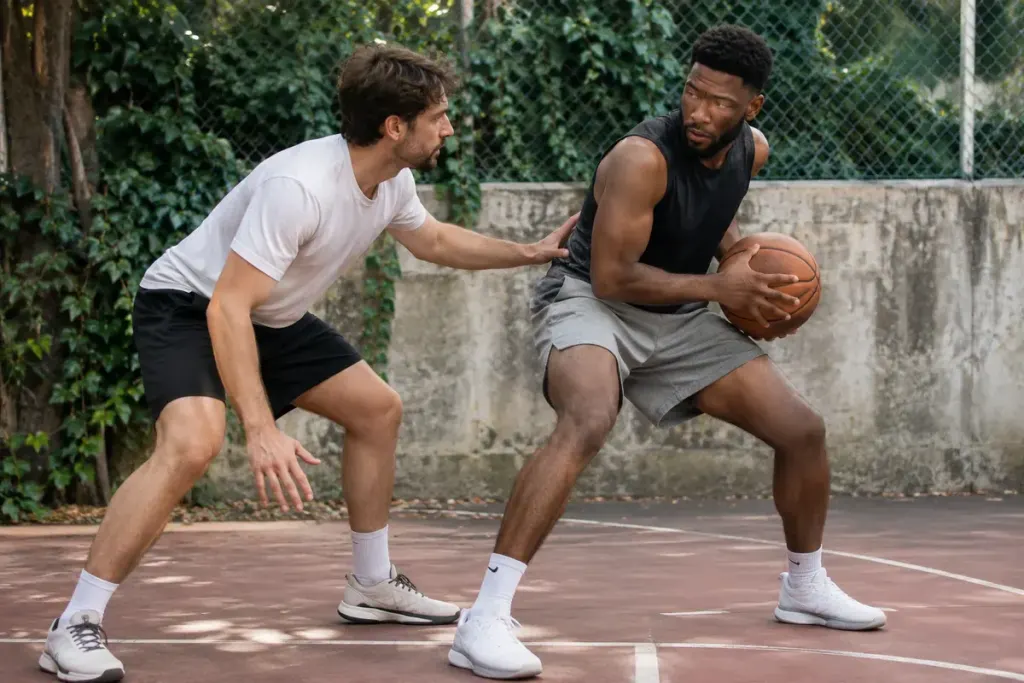
A player catches the ball, surveys the court and keeps holding it while a defender stays close. The shot clock may show plenty of time, but another rule can already matter. FIBA’s closely guarded provision concerns that individual possession of the ball, not simply the time remaining for the team to shoot.
Article 27 of the FIBA Official Basketball Rules 2026 defines a closely guarded player as someone holding a live ball on the court while an opponent is in an active legal guarding position no more than one metre away. The player must pass, shoot or dribble within five seconds.
The conditions matter together. A nearby person is not automatically applying active legal guarding, and the article describes holding the ball. Do not replace the rule with a loose instruction that any player near a defender has five seconds to do anything.
Practise seeing the next option
For a controlled training exercise, have a receiver catch a pass while a defender takes a legal position nearby. Add one passing teammate. Work at a manageable speed and ask the receiver to identify an available action promptly. The aim is to recognise options, not to encourage the defender to make illegal contact.
After each attempt, discuss what the receiver could see before the catch. Was the teammate available? Was there space for a legal dribble? Was a shot sensible from that location? These are coaching questions; the rule does not make every possible action equally useful.
If the player has already ended a dribble, starting another one is not a lawful escape. The practical options must also comply with the other playing rules. A rushed decision that creates a separate violation does not solve the original problem.
Keep different five-second situations separate
A throw-in has its own timing provisions. Hearing “five seconds” from the sideline does not tell you which rule applies. When reviewing a clip, identify whether the ball is being held on the court or administered from out of bounds before judging the sequence.
Use the rules adopted by the actual competition, especially when moving between basketball organisations. A clear explanation begins with that rule set and the visible conditions, rather than assuming every league treats a closely guarded ball-handler identically.