
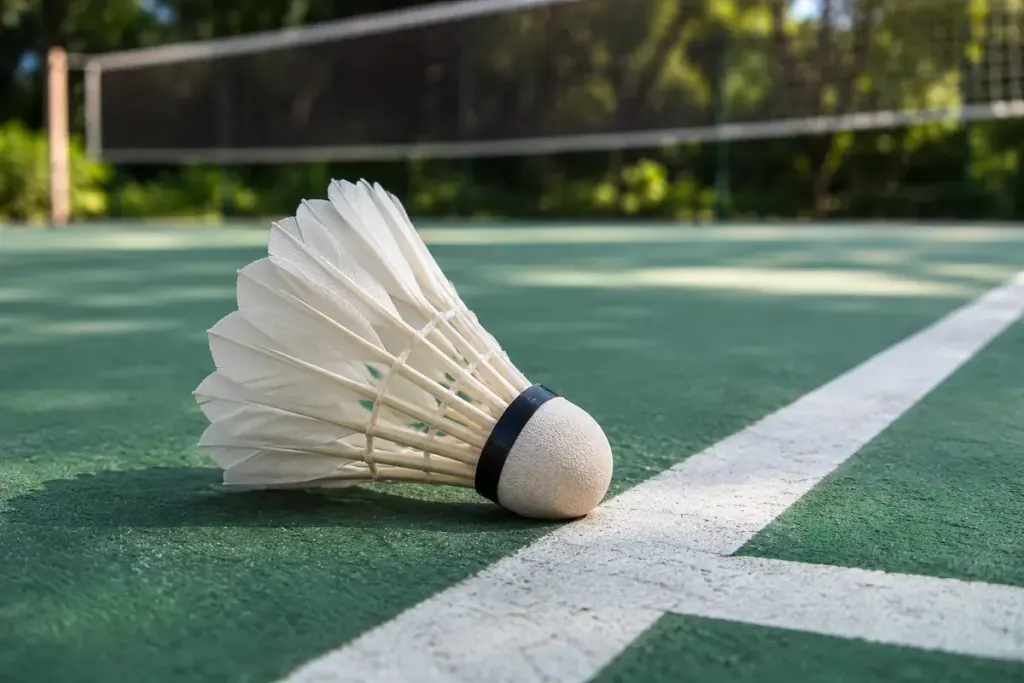
A shuttle lands near a boundary, tumbles, and comes to rest with feathers over the white line. One player points to the feathers; the other points to the cork. The useful question is earlier in time: where did the shuttle first touch the floor?
Its final resting position is not a reliable reconstruction of that instant. A shuttle can bounce or roll after landing, and the visible spread of its feathers can distract from the first contact.
Why “look at the cork” is useful but incomplete
The BWF Line Judges’ Manual explains that the shuttle almost always lands base first. It also notes that a smash can bring the side and feathers into almost simultaneous contact. The principle remains the first point of contact, rather than an absolute instruction to ignore every part except the base.
A first contact on the relevant boundary line is in. First establish which boundary applies to that rally or service: the painted court contains several lines, and not all of them define the active area in every situation.
A simple way to understand the disagreement
During practice, place a shuttle beside a line and tilt it so that the feathers extend over the paint while the base remains outside. This is only a demonstration of overhang, not a recreation of a real landing. Now move the base onto the line. The exercise shows why the silhouette viewed from above can be misleading.
For moving examples, review suitable slow-motion training footage and stop at the first visible floor contact. If the camera angle hides the contact or the frame rate misses it, acknowledge that limitation. A blurred still image does not become decisive merely because it has been enlarged.
In an officiated match, follow the competition’s process for decisions and any available review. In casual play, agree beforehand how to handle genuinely uncertain calls. Repositioning the shuttle after the rally cannot prove where it originally landed.
Understanding the rule makes discussion more precise: talk about the applicable line and the initial contact. The feathers lying on the floor a moment later may be visually persuasive, but they answer a different question.