
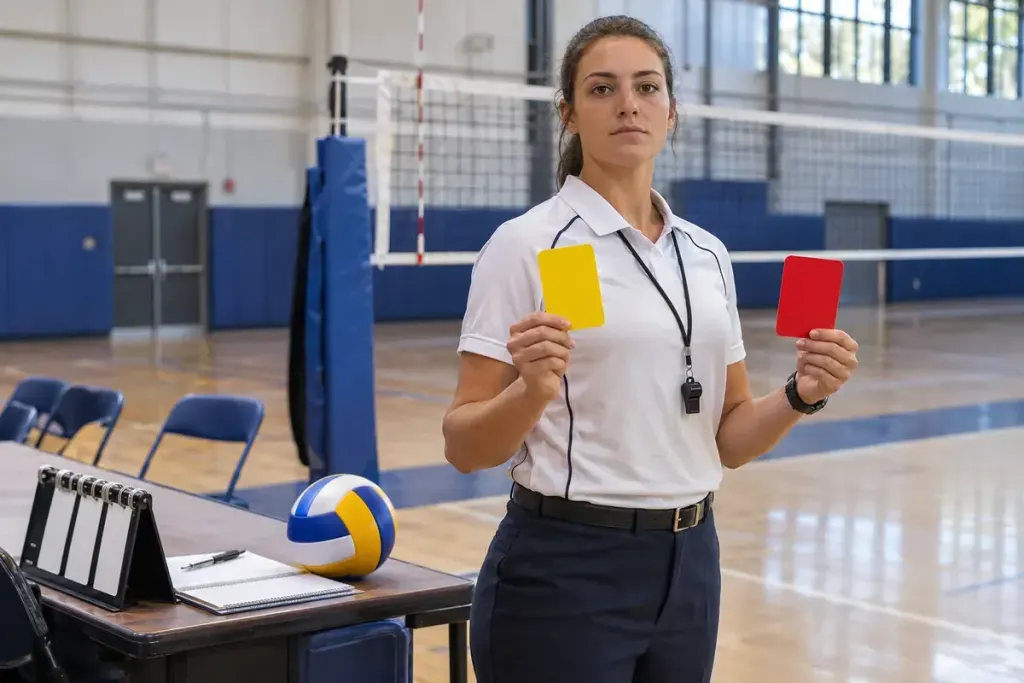
A volleyball team receives a delay warning in the first set. Later, another team member causes a delay, and the referee awards the opponents a point and service. The sequence can be correct even though a different person was involved and a new set has begun.
Under FIVB Official Volleyball Rules 2025–2028, rule 16, delay sanctions belong to the team and remain in force throughout the match. The first delay receives a warning; second and subsequent delays by that team receive a penalty. They are recorded on the score sheet.
Follow the team record
Types of delay include prolonging an interruption after being told to resume, an illegal substitution request and repeated improper requests. A delay penalty gives a point and service to the opponent. A sanction imposed before or between sets is applied in the following set.
Rule 15.11 separately addresses an initial improper request that does not affect or delay the game: it is rejected and recorded without another consequence. That distinction is why “every rejected request costs a point” is an unreliable shortcut.
Here is a fictional viewing exercise:
- In set one, note the team’s first recorded delay warning.
- In set two, observe a later action that the referee judges to be a delay.
- Check the team record rather than looking only for a previous warning to that individual.
- Separate the delay sanction from any discussion of personal misconduct.
The example demonstrates how to follow the sequence; it does not let a spectator determine every disputed call from a broadcast angle. The scorer and referees have responsibilities and information that may not be visible on screen.
When watching a replay, write down the set, score and signal, then consult the relevant rule. Avoid merging a delay warning, a misconduct warning and an ordinary playing fault just because cards or whistles appear in each situation.
Finally, check the competition’s adopted rules and regulations. This explanation concerns the cited FIVB indoor rules. A local league or different volleyball format may use another framework, so the match’s own rules remain the starting point for interpreting its decisions.