
A basketball clip starts halfway through a move. Someone counts two steps, someone else counts three, and the argument begins. Often the missing detail happened before either count: when did the player control the ball, and which foot became the pivot?
For a beginner’s practice session, a stationary catch is a cleaner starting point than a moving highlight. Keep the exercise separate from the additional rules that govern catching while progressing, ending a dribble and different landing sequences.
Start before the interesting part
Watch the player’s feet and hands together. Pause before the catch, then follow the movement continuously. A freeze-frame of one raised foot cannot establish the entire sequence, and an obstructed camera angle may leave an important detail uncertain.
Use the rulebook for the competition you are discussing. FIBA publishes its official rules and related material; Article 25 is the place to check travelling and pivot-foot provisions. Do not assume an explanation written for another league covers every situation in the same way.
Practise identifying one fixed contact point
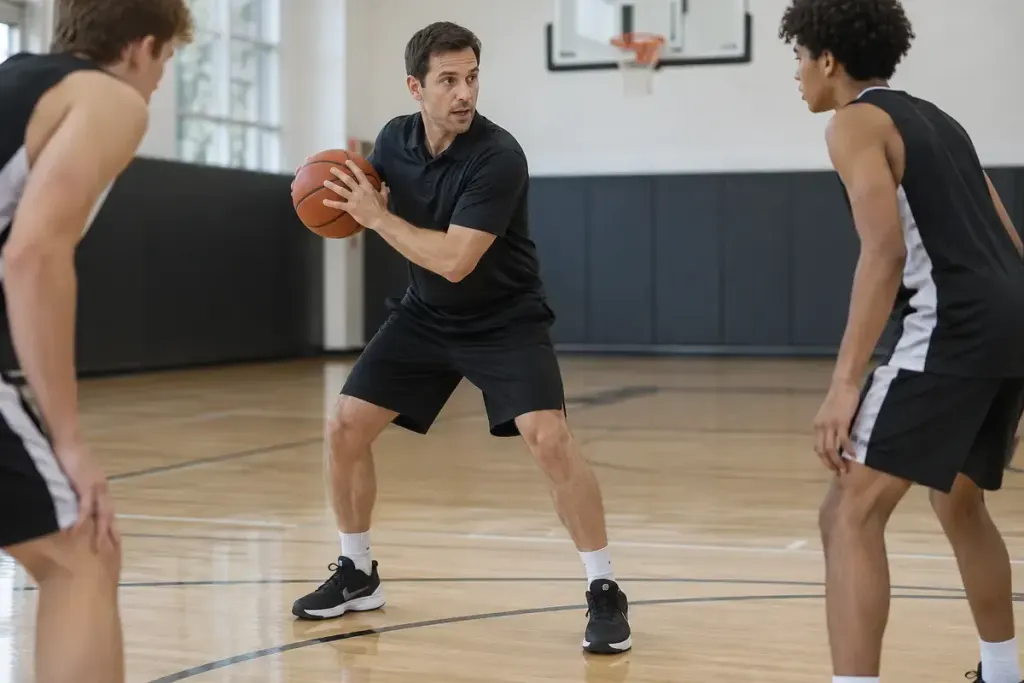
In a controlled exercise, catch the ball while stationary with both feet on the floor. Have a coach identify the pivot as you begin the movement, then practise turning slowly while keeping that foot’s contact point in place.
The aim is to recognise the sequence, not to spin quickly. Use a clear patch of court, suitable shoes and enough space between players. Begin without a defender so that pressure does not hide the footwork you are trying to learn.
Ask the coach to demonstrate the different requirements when starting a dribble and when passing or shooting. Treat those as separate repetitions. A memorised phrase such as “you can take two steps” is too vague to settle every example.
Review the whole action
If you record practice, position the camera where both feet and the ball remain visible. Watch once at normal speed, then slowly. Identify the catch, the foot movement and the ball’s release in that order.
When the recording does not show a critical moment, say so. Learning to leave an unclear clip unresolved is more useful than confidently assigning a violation from missing evidence.
A good footwork discussion begins with what can be observed and the relevant rule. Counting steps becomes meaningful only after that foundation is in place.