
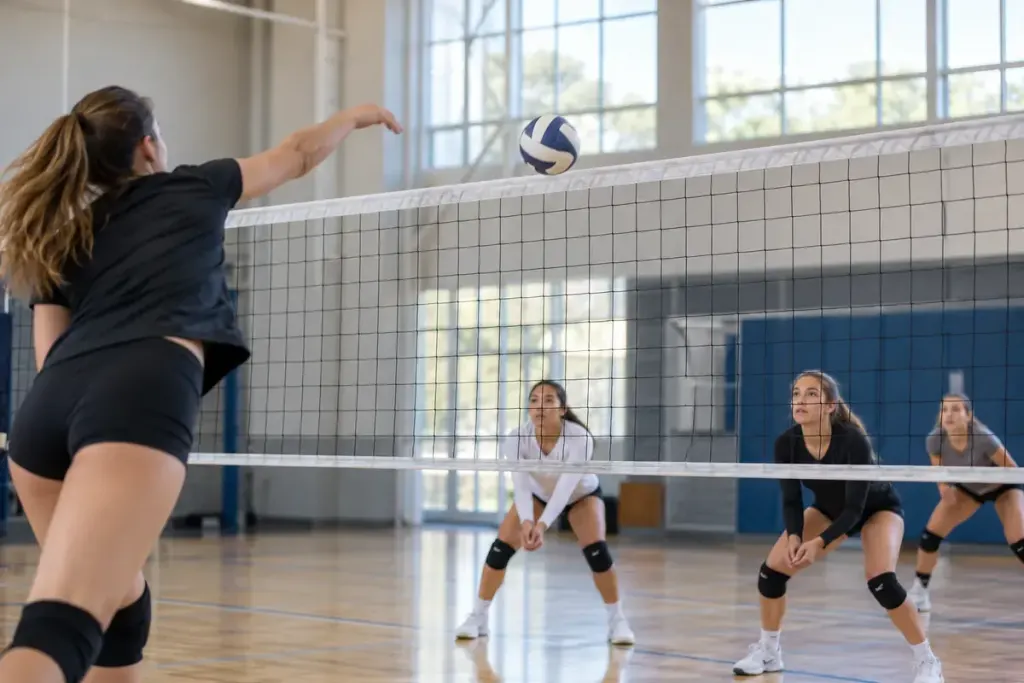
A serve brushes the top of the net and drops into the receiving court. Some spectators stop watching, expecting a replay. Under the FIVB indoor rules, touching the net does not by itself end a ball’s legal crossing.
Rule 10.2 of the FIVB Official Volleyball Rules 2025–2028 allows the ball to touch the net while crossing. The serve must still satisfy the other relevant rules, including passing through the correct crossing space.
Follow the ball after the touch
If the serve clips the net and crosses legally, the receiving team must remain ready to play it. The contact can change the ball’s speed or path, which is why stopping at the sound of the net can cost the team a playable ball.
If the ball fails to cross, travels outside the permitted space or lands out, those are different outcomes. “It touched the net” is not enough information to decide the rally. Watch the rest of the flight and the referee’s signal.
Do not confuse the ball with a player
The rules for a player’s contact with the net are separate. A legal ball touch does not mean a player may use the net for support or touch it in any situation without consequence. Keep those two questions distinct when discussing a replay.
For a simple viewing exercise, pause a rally just after a serve contacts the net and predict what information is still needed. Did the ball cross between the antennae? Where did it land or who played it next? Then watch the continuation instead of judging from one frame.
In a practice session, a coach can remind receivers to continue tracking a served ball after a net deflection. The aim is readiness and communication, not deliberately moving dangerously close to the net to chase every unpredictable bounce.
Check the rules used by your competition, particularly for modified recreational formats. For standard FIVB indoor play, the basic lesson is clear: a net touch can be part of a live serve. The receiving team still has a job to do.