
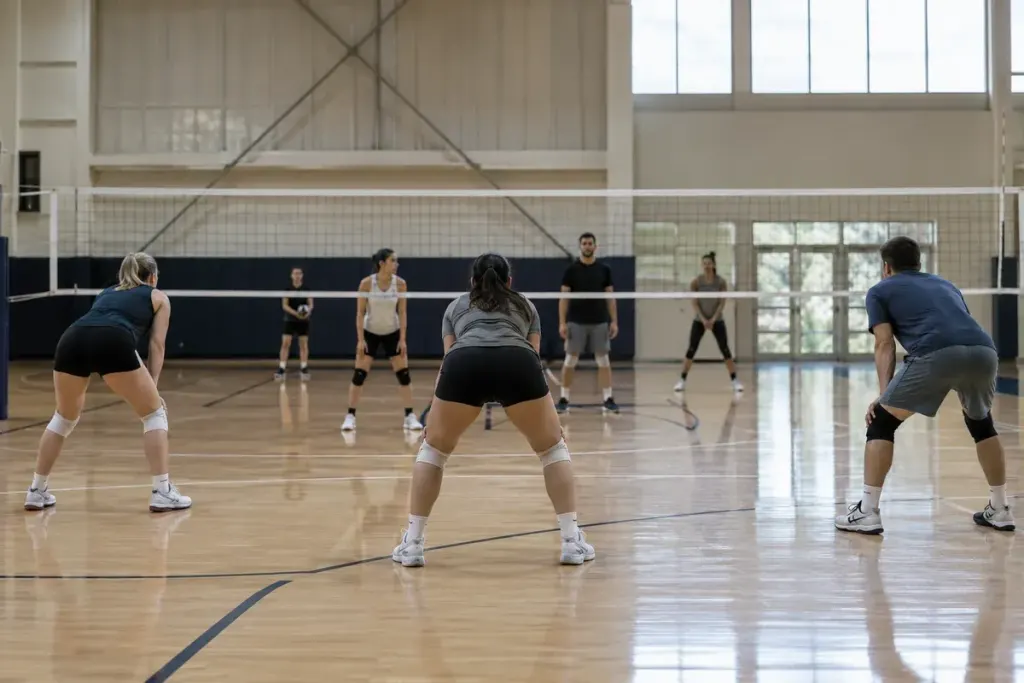
A serve lands between two passers and both look at each other. The problem may involve technique, but it can also begin before either player touches the ball. The space between receivers needs a shared understanding of responsibility, adjusted to the team’s formation and the serve.
For a viewer, that makes serve receive a useful part of the match to study. Watch the receiving team before contact rather than waiting for a good or bad pass to decide what happened.
Start with the formation
Notice how many players are receiving and where they begin. Look at the server’s position and the areas the receivers appear ready to cover. A seam is not simply a permanent line drawn down the court; responsibilities can change with the rotation, players and tactical plan.
Do not assume one universal rule such as the player on a particular side always takes the ball. Teams use different systems. If you are playing, confirm the rule with your coach and teammates rather than importing one from an unrelated video.
Watch the first decision
Track which passer moves first, whether a clear call occurs and how the other players respond. The final platform contact is only the end of that sequence. USA Volleyball’s discussion of serve reception emphasises reading the serve and communicating about who will receive it.
An illustrative observation might be that both passers initially moved towards a short serve, then one stopped too late to leave a clean route. That description gives a team something to discuss. Saying they need more confidence may miss the actual coordination problem.
Practise the decision in a relevant setting
Under appropriate coaching, receive actual serves at a level the players can manage, with clear starting responsibilities and a target for the pass. Review seam balls specifically: who called, when the decision became clear and whether the formation needs adjustment. Do not turn practice into repeated blame for the person nearest the landing point.
For match analysis, compare several similar serves before drawing a conclusion. A camera angle may hide communication, and one difficult ball does not establish a persistent weakness. Good serve receive combines reading, movement, technique and coordination. Watching the space between players helps reveal how those elements work together.