

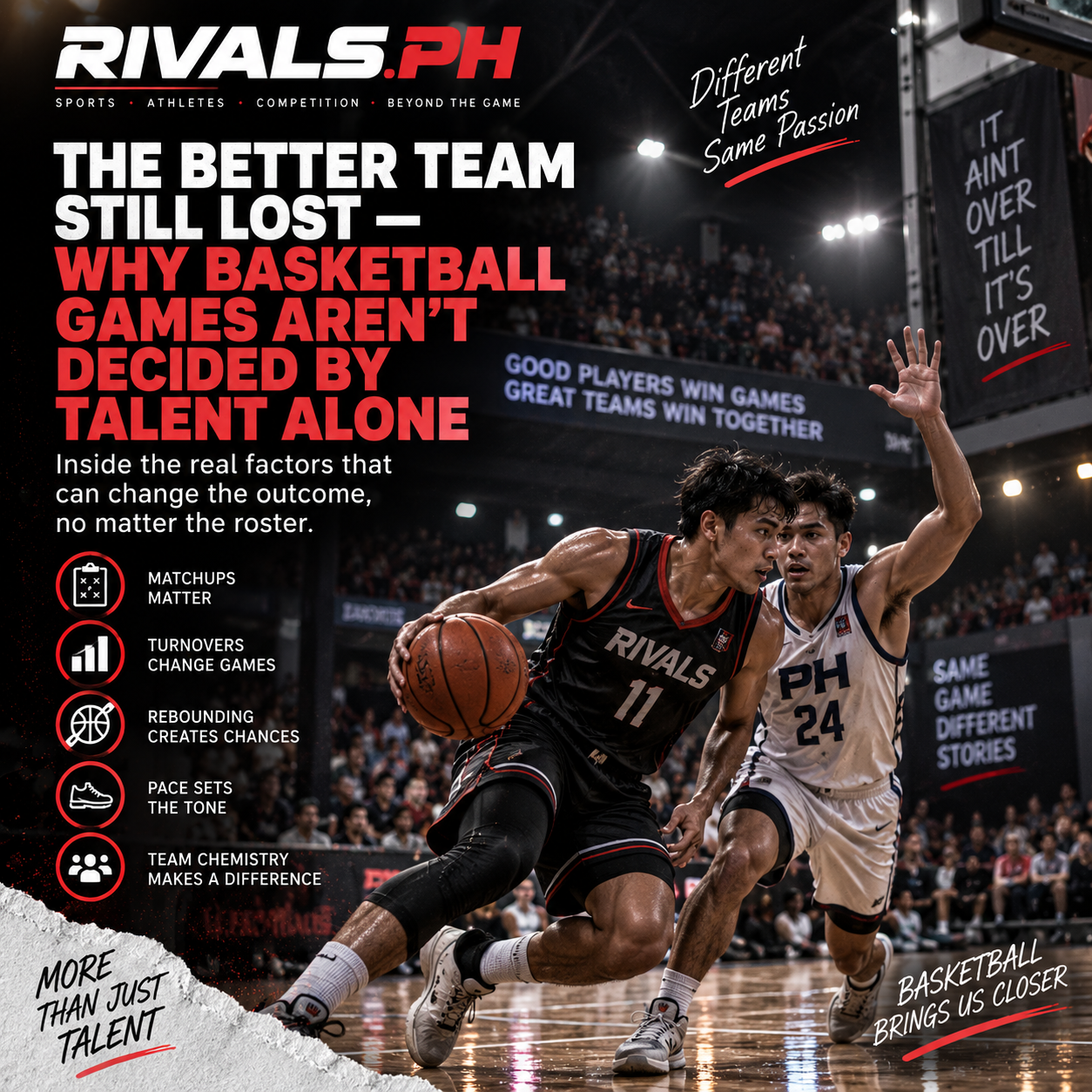
The game ends.
You look at the scoreboard.
Then look at both rosters again.
And think:
“How did THAT team lose?”
One side had the bigger names.
Better scorers.
More athletic players.
More experience.
Maybe they were even heavy favorites before tip-off.
Yet somehow the supposedly weaker team walks away with the win.
Fans immediately start searching for explanations.
Bad shooting?
Bad coaching?
Players weren’t trying?
Referees?
Maybe.
But basketball is rarely that simple.
Understanding why better basketball teams lose games starts with one important idea:
the team with the most talent does not automatically become the better team for those 48 minutes.
Talent matters enormously.
But games are decided by how that talent interacts with matchups, possessions, decisions, execution, and sometimes plain old shooting variance.
Basketball Is a Possession Game
A spectacular dunk is worth two points.
So is an ordinary layup.
A beautiful fadeaway?
Usually two.
A wide-open three?
Three.
Basketball may look like a collection of individual highlights, but underneath everything is a simpler battle:
What does each team do with its possessions?
If one team repeatedly wastes possessions while the other creates efficient opportunities, individual talent can quickly become less important.
Turnovers Quietly Destroy Favorites
Imagine Team A has significantly better offensive players.
But they commit:
18 turnovers.
Team B commits:
That’s ten additional possessions Team A potentially lost.
Some turnovers also create:
fast breaks,
open threes,
layups,
or defensive mismatches.
Now Team A is not simply losing the ball.
It may be handing the opponent efficient scoring opportunities.
Not All Turnovers Are Equal
Throw the ball out of bounds?
Bad.
But at least the defense gets time to set.
Throw a lazy pass directly to a guard who immediately starts a fast break?
Much worse.
Live-ball turnovers can be particularly damaging because the offense suddenly becomes the defense while players are:
out of position,
running backward,
and trying to stop transition.
A few of these can completely change momentum.
Rebounding Creates Extra Chances
Team A defends beautifully.
Opponent misses.
Great possession.
Except…
the opponent gets the offensive rebound.
Another shot.
Miss.
Another rebound.
Third attempt.
Score.
The defense technically forced two misses and still gave up points.
Why?
The possession never ended.
Defensive rebounding is part of defense.
Offensive Rebounds Can Change an Entire Game
A team does not need to shoot brilliantly if it keeps recovering its own misses.
Second-chance opportunities can compensate for lower shooting percentages.
They can also create:
kick-out threes,
putbacks,
fouls,
and defensive scrambling.
A team that dominates the offensive glass may simply receive more opportunities to score.
More Possessions Can Beat Better Shooting
Suppose one team shoots slightly more efficiently.
But the opponent gets significantly more attempts because of:
offensive rebounds,
fewer turnovers,
and better possession control.
Suddenly the efficiency advantage may disappear.
Basketball is not only about:
How well did you shoot?
It is also:
How many useful opportunities did you create?
Matchups Can Make a Good Team Look Bad
Team rankings tell you overall quality.
They do not guarantee every matchup will be favorable.
Imagine a strong team built around a dominant interior scorer.
Then they face an opponent particularly good at:
protecting the paint,
sending help,
and forcing the ball outside.
Suddenly their biggest advantage becomes harder to use.
The team did not become bad overnight.
They encountered a difficult matchup.
Size Can Create Problems
A smaller team may struggle against:
post scoring,
offensive rebounding,
rim protection,
and physical defense.
But bigger lineups can have weaknesses too.
They may struggle defending:
quick guards,
perimeter actions,
transition,
or five-out spacing.
Every advantage potentially creates another vulnerability.
Speed Can Beat Size
A team with smaller, faster players may intentionally increase the pace.
Why?
They do not want the opponent’s big lineup comfortably establishing half-court defense.
Run.
Attack early.
Force big defenders to move.
Create mismatches before everyone gets organized.
Now the game is being played under conditions that favor the smaller team.
Or the Bigger Team Can Slow Everything Down
The reverse also works.
Facing an athletic transition team?
Slow the game.
Protect the ball.
Use longer possessions.
Force them into half-court offense.
Make every basket require patience.
Basketball strategy is partly about forcing the opponent to play your type of game.
Pace Changes the Number of Opportunities
Fast games create more possessions.
Slow games create fewer.
This matters for underdogs.
Imagine playing a much stronger opponent.
Would you prefer giving them:
100 chances to demonstrate their superior talent?
Or 70?
Generally, fewer possessions can increase the importance of each individual:
shot,
turnover,
rebound,
and mistake.
That can make the result more volatile.
Three-Point Shooting Makes Upsets Possible
Team A attacks the paint consistently.
Team B takes a lot of threes.
On most nights, maybe Team A is better.
But tonight?
Team B hits everything.
Suddenly:
three,
three,
three.
A small shooting hot streak can create a large scoring difference quickly.
That is one reason modern basketball can produce dramatic swings.
The Math of a Hot Shooting Night Is Brutal
Imagine an underdog makes five more three-pointers than expected.
That’s:
15 additional points.
A 15-point difference can transform a game.
The stronger team may not have played terribly.
Sometimes the opponent simply had an unusually efficient shooting night.
Good Shots Can Still Miss
This is important when evaluating one game.
A player:
gets open,
takes a good shot,
misses.
Was the possession bad?
Not necessarily.
Meanwhile another player:
takes a difficult contested three,
makes it.
Was that automatically great offense?
Also not necessarily.
Results and decision quality are related, but they are not identical.
Basketball Contains Variance
Players do not shoot their exact season percentage every night.
A 40% three-point shooter does not mechanically make four of every ten shots in every game.
They might go:
1-for-8 tonight,
then 6-for-9 tomorrow.
Over larger samples, performance becomes easier to evaluate.
One game can be messy.
That’s Why One Upset Doesn’t Prove Everything
Team B beats Team A.
Does that automatically mean Team B is better?
No.
It means Team B won that game.
Maybe they would also win a seven-game series.
Maybe they would lose the next five meetings.
Single-game results contain more randomness than long-term records.
This is why tournaments can feel so dramatic.
Foul Trouble Can Remove an Advantage
Your best defender commits two early fouls.
Coach sends them to the bench.
Now the opponent attacks their replacement.
Later, your center picks up another foul.
Suddenly they cannot defend as aggressively.
One player’s foul situation can affect the entire strategy.
A Player Doesn’t Need to Foul Out to Be Limited
Suppose a rim protector has four fouls.
Technically still available.
But are they defending exactly the same way?
Maybe not.
They may become more cautious challenging:
drives,
post moves,
or offensive rebounds.
The opponent can intentionally attack them.
Foul trouble changes behavior.
Free Throws Are Quiet Points
Fans remember:
dunks,
threes,
game winners.
But free throws can decide games without producing dramatic highlights.
One team repeatedly attacks the rim and draws contact.
The other settles for difficult jump shots.
At the end:
one team attempted 28 free throws.
The other attempted 11.
That difference matters.
Shot Selection Matters
Two teams can attempt the same number of shots while generating completely different quality.
One gets:
layups,
open threes,
free throws.
The other gets:
contested mid-range shots,
late-clock attempts,
difficult isolation jumpers.
Same number of attempts.
Different offensive quality.
Stars Can Actually Make Offense Predictable
This sounds strange.
Having a superstar is obviously valuable.
But sometimes a team becomes too dependent on one player.
Every important possession becomes:
give star ball,
everyone move,
star creates something.
The opponent knows.
So they:
double-team,
trap,
deny,
switch,
or force the ball toward weaker creators.
Talent remains.
Predictability becomes the problem.
“Give the Ball to the Best Player” Has Limits
Late in games, teams naturally rely on their best creators.
But if four teammates become spectators, the defense’s job becomes easier.
Strong offenses force defenders to make multiple decisions.
Cut.
Screen.
Move.
Attack.
Pass.
Relocate.
Now the defense cannot focus on one threat.
Ball Movement Forces Defensive Decisions
Every pass can make defenders:
rotate,
communicate,
close out,
switch,
or recover.
Eventually someone makes a mistake.
An extra pass may create a better shot than a difficult attempt from the team’s best scorer.
This is where team basketball can overcome individual talent.
Chemistry Shows Up in Small Moments
Team chemistry sounds vague until you watch:
help defense,
rotations,
screens,
cuts,
box-outs,
transition communication.
Players who understand one another often react faster.
They know:
where teammates prefer the ball,
when someone will cut,
who rotates next,
and when help is coming.
Those fractions of a second matter.
Five Talented Players Are Not Automatically a Great Lineup
Imagine five players who all need the ball.
Who:
sets screens?
cuts?
rebounds?
defends the opponent’s best player?
moves without the ball?
accepts fewer shots?
A roster needs complementary skills.
Not simply the highest possible collection of individual scoring averages.
Roles Matter
Strong teams usually understand:
who creates,
who finishes,
who defends,
who rebounds,
who organizes,
who spaces the floor.
That does not mean players can only perform one function.
But clarity helps.
When everyone tries to become the hero on the same possession, offense can collapse.
Bench Minutes Can Decide Games
Starters receive most of the attention.
But basketball games include long stretches where bench players matter.
Suppose both starting lineups are evenly matched.
Then one team’s second unit wins its minutes by 12 points.
That may become the difference.
Depth matters because stars cannot realistically play every minute at maximum intensity.
Fatigue Changes Everything
A shot taken in the first quarter is not physically identical to one taken after 40 minutes of:
running,
defending,
screening,
jumping,
and absorbing contact.
Fatigue can affect:
shooting mechanics,
decision-making,
defensive effort,
and transition speed.
A team that forces opponents to work hard early may benefit later.
Defense Can Tire Out Great Scorers
Imagine a star guard.
On offense, they create almost everything.
On defense, the opponent repeatedly involves them in actions.
Screen.
Switch.
Drive.
Another screen.
Post-up.
Run in transition.
Now the star’s workload increases on both ends.
The goal may not be scoring directly against them every possession.
It may simply be making them work.
Coaching Adjustments Matter
Basketball is a moving puzzle.
Something works in the first quarter.
Opponent adjusts.
Now it stops working.
Good coaching involves recognizing:
matchups,
spacing problems,
defensive coverages,
lineup weaknesses,
and tempo changes.
Then responding.
A talented team that adjusts slowly can lose to a less talented team with a better plan for that particular matchup.
Timeouts Are Not Magic Buttons
Fans love:
“Coach should call timeout!”
Sometimes yes.
But a timeout does not automatically fix:
bad spacing,
poor shooting,
turnovers,
foul trouble,
or matchup disadvantages.
It gives the team an opportunity to reorganize.
Players still need to execute.
Small Lineup Changes Can Change Everything
One substitution can alter:
spacing,
switchability,
rebounding,
pace,
and defensive matchups.
Maybe a team removes a traditional big and adds another shooter.
Suddenly the paint opens.
Or they add size and begin dominating rebounds.
The names may not be famous.
The lineup interaction matters more.
Momentum Feels Real—But Be Careful
Opponent hits three straight threes.
Crowd erupts.
Timeout.
Suddenly it feels like an unstoppable wave.
Players can certainly respond psychologically to runs.
But “momentum” can also make us overlook specific causes.
Maybe the run happened because of:
two turnovers,
one offensive rebound,
and a missed defensive rotation.
Instead of saying:
“They had momentum,”
ask:
“What created the run?”
That’s usually more useful.
Home Court Can Matter
Playing at home can bring:
familiar surroundings,
less travel,
crowd energy,
and routine.
Communication can also become harder for visiting teams in loud environments.
Home court does not guarantee victory.
But across many competitions, location can influence performance.
Travel Can Quietly Affect Teams
Back-to-back games.
Flights.
Different hotels.
Changing routines.
Limited recovery.
Athletes are highly conditioned, but they remain human.
A team playing its fourth game in six days may not perform like the same team after two days of rest.
Context matters.
Injuries Are Not Always Visible on the Injury Report
A player may technically be available while dealing with:
minor soreness,
reduced mobility,
conditioning issues,
or recovery from a recent injury.
They play.
So fans assume:
“Everyone was healthy.”
But availability and 100% performance are not always the same thing.
One Weak Defender Can Become the Target
Basketball offenses search for advantages.
If one defender consistently struggles, the opponent may involve them repeatedly.
Set a screen involving that player.
Force a switch.
Attack.
Next possession?
Do it again.
The defense then needs to adjust, potentially creating another weakness somewhere else.
Playoff Basketball Makes This Even More Obvious
Repeated games against the same opponent create deeper tactical battles.
Weaknesses become harder to hide.
Teams learn:
actions,
tendencies,
matchups,
and preferred counters.
What worked in Game 1 may disappear by Game 3.
Then another adjustment begins.
This is one reason playoff series can look completely different from regular-season meetings.
Esports Fans Will Recognize This Immediately
Interestingly, the same general concept exists in esports.
The team with mechanically stronger players does not automatically win.
Drafts.
Maps.
Team composition.
Communication.
Objective control.
Strategy.
Adaptation.
All influence results.
Competition rewards performance within a specific environment—not talent in isolation.
Upsets Are Part of Why Sports Work
Imagine if the favorite always won.
Why watch?
We could simply compare rosters before the game and go home.
Sports are interesting because outcomes must be earned in real time.
A weaker team can:
prepare better,
execute better,
create the right matchup,
shoot unusually well,
or simply make fewer mistakes.
That’s not a flaw.
That’s competition.
How to Watch a Game Beyond the Scoreboard
Next time an underdog starts winning, do not immediately ask:
“Why is the favorite playing badly?”
Watch a few specific things.
1. Turnovers
Who is giving away possessions?
2. Offensive rebounds
Who is getting second chances?
3. Shot quality
Which team is generating easier attempts?
4. Three-point shooting
Is one side having an unusually hot or cold night?
5. Fouls
Are important players limited?
6. Pace
Which team is controlling the speed of the game?
7. Matchups
Is someone repeatedly being targeted?
8. Bench minutes
What happens when the stars rest?
Suddenly the game becomes much easier to understand.
The Box Score Can Tell Part of the Story
After the game, look beyond points.
Check:
field-goal attempts,
three-point attempts,
free throws,
turnovers,
offensive rebounds,
assists,
and individual minutes.
You may immediately discover why the result was less surprising than it looked.
But Statistics Still Need Context
Suppose one team has more assists.
Does that automatically mean better offense?
Not necessarily.
More rebounds?
Maybe because the opponent missed more shots.
More free throws?
Could reflect aggressive rim attacks, specific matchups, or game situations.
Statistics help explain basketball.
They do not eliminate the need to watch it.
Great Teams Win in Multiple Ways
This may be the biggest difference between good and elite teams.
A good team may dominate when its preferred style works.
A great team can sometimes survive when it doesn’t.
Three-point shots not falling?
Attack differently.
Transition unavailable?
Execute half-court offense.
Star gets trapped?
Find the open teammate.
Opponent goes small?
Punish the size disadvantage.
Versatility reduces the number of ways an opponent can beat you.
Consistency Separates Teams Over a Season
One game can be strange.
A season is harder to fake.
Over many games, strong teams repeatedly demonstrate:
execution,
depth,
adaptability,
discipline,
and talent.
That is why long-term records tell us more than one surprising result.
But every individual game still needs to be played.
Thankfully.
Otherwise sports would be incredibly boring.
FAQ
Why do stronger basketball teams sometimes lose to weaker teams?
Individual games are influenced by turnovers, rebounding, shooting variance, matchups, foul trouble, pace, fatigue, lineup combinations, and execution. A more talented roster can therefore lose if the opponent performs better in those areas.
How important are turnovers in basketball?
Turnovers remove scoring opportunities and can create easy transition chances for the opponent. Live-ball turnovers can be particularly damaging because the defense may not have time to organize.
Can rebounding decide a basketball game?
Yes. Offensive rebounds create additional scoring opportunities, while defensive rebounds are necessary to finish defensive possessions. A team dominating the glass may overcome disadvantages elsewhere.
Why are three-pointers important for underdogs?
Three-point shooting can create large scoring swings quickly. An unusually strong shooting night can help an underdog overcome differences in overall talent.
Does the better team always win a playoff series?
No, but longer series generally reduce some of the randomness present in a single game. Repeated matchups also allow teams to make tactical adjustments and exploit weaknesses more consistently.
Is team chemistry more important than individual talent?
Both matter. Individual talent creates advantages, while chemistry helps players coordinate roles, movement, defensive rotations, communication, and decision-making. The strongest teams usually combine both.
Conclusion
The final buzzer sounds.
The favorite lost.
It is tempting to say:
“They were obviously the better team. They just had a bad night.”
Maybe.
But look closer.
Did they turn the ball over?
Lose the rebounding battle?
Allow too many open threes?
Get into foul trouble?
Struggle with a specific matchup?
Let the opponent control the pace?
Sometimes the surprising result stops looking so surprising once you examine the possessions behind the scoreboard.
Talent gives teams options.
It creates advantages.
It raises the ceiling.
But talent still has to be converted into good basketball.
Because once the ball goes up, reputation stops scoring points.
The team that plays better that night still gets the win.