

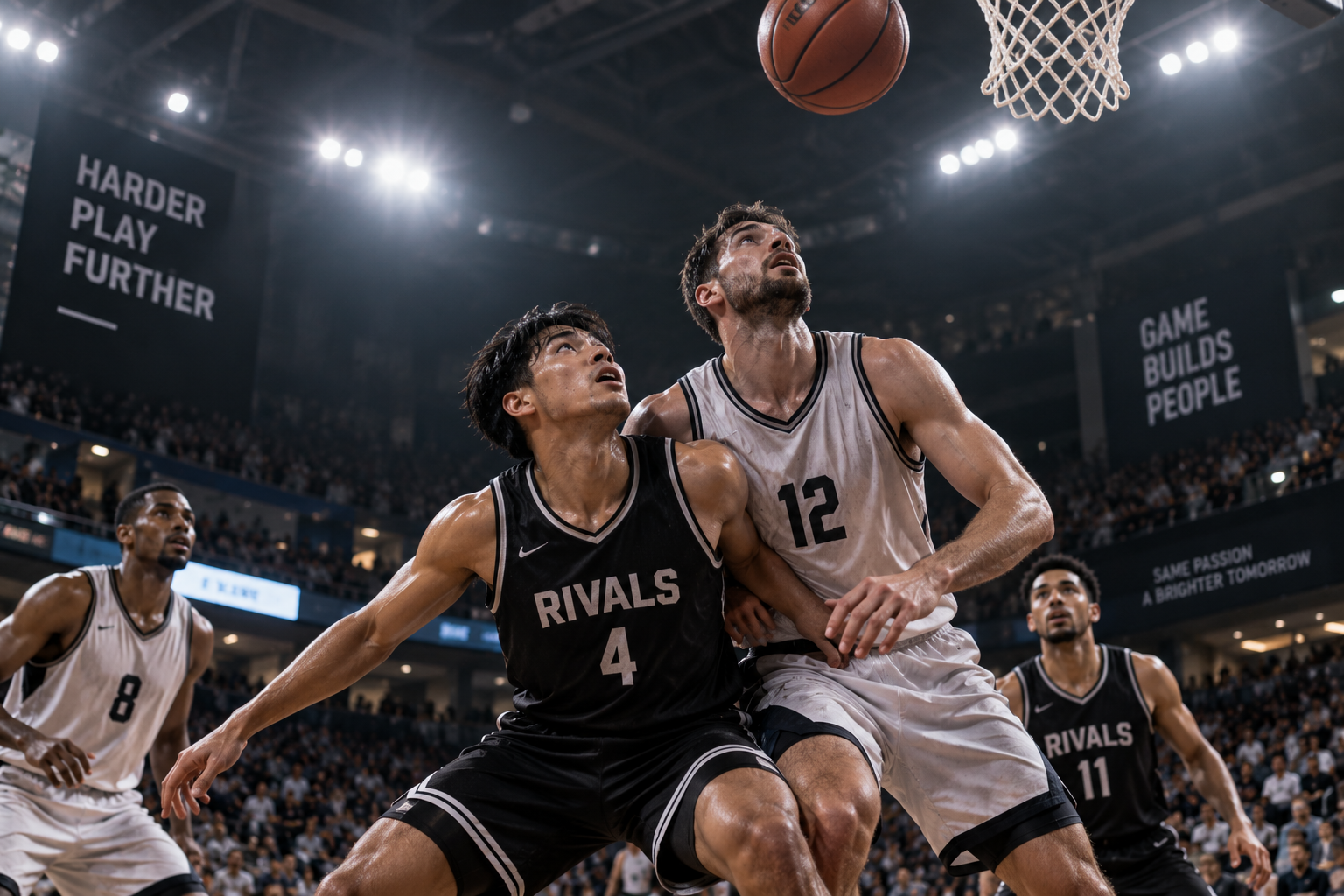
The shot goes up.
Everyone looks at the rim, two players jump, and somehow the shorter player comes away with the ball again.
From the outside, rebounding can look like one of basketball’s simplest equations: taller player plus higher jump equals more rebounds.
Height and athleticism certainly help. But watch good rebounders closely and much of the possession is decided before either player leaves the floor.
They find an opponent. They create contact. They anticipate where the ball may travel. They establish inside position and move toward the rebound instead of waiting underneath the rim.
That is why understanding basketball rebounding positioning can matter just as much as jumping ability. Rebounding is not simply about reaching higher. It is about being in the right space when the ball finally comes down.
A Rebound Starts Before the Ball Hits the Rim
Many players react to a missed shot only after they see where the ball is going.
By then, they may already be late.
Good rebounders begin working when the shot leaves the shooter’s hand.
They recognize that a rebound may happen, locate the nearest opponent, establish position, and prepare to move toward the ball.
Those few moments create an advantage.
Instead of competing for an open ball from equal positions, they are shaping the space before the rebound exists.
Stop Watching the Shot for Too Long
Ball watching is one of the easiest ways to lose rebounding position.
The shot goes up and your eyes naturally follow it.
Meanwhile, the offensive player beside you moves around your body and reaches the lane first.
You may know exactly where the ball is going but no longer have access to it.
Defensive rebounding requires awareness of both the ball and the opponent.
You need enough information about the shot to react, but you also need to prevent your matchup from getting unrestricted access to the rebound.
Find the Player Before Finding the Ball
A useful defensive sequence is simple:
Find your opponent, make legal contact, establish position, then pursue the ball.
This is the basic logic behind boxing out.
The goal is not to shove someone away from the basket.
Instead, you use your positioning to place your body between the opponent and the likely rebounding area.
Once that advantage is established, you can locate the ball and attack it.
Skipping the first step often turns the possession into a jumping contest—which is exactly what you want to avoid against a taller or more explosive player.
Boxing Out Is Not Just Standing in Front of Someone
A player can technically be between an opponent and the basket and still perform a poor box out.
Effective positioning is active.
You need balance, awareness, and enough contact to understand where the opponent is trying to move.
If you simply stand still, an aggressive rebounder can circle around you.
Think of the box out as temporarily controlling a pathway.
You are making the opponent take a longer or more difficult route toward the ball.
That extra distance can be enough to win the possession.
Inside Position Changes the Jumping Contest
Imagine two players who can reach different heights.
If both jump from the same spot at the same time, the taller or more explosive player has an obvious advantage.
But rebounds rarely happen under perfectly equal conditions.
If the shorter player has established inside position, the taller player may be forced to reach over, around, or from farther away.
Now the physical advantage becomes harder to use.
Good basketball rebounding positioning changes the geometry of the play before athleticism enters the equation.
The Ball Does Not Always Come Straight Down
Players sometimes crowd directly underneath the basket because that feels like the logical place to rebound.
But missed shots can travel several feet away from the rim.
The ball may hit the front rim and fall short.
It may strike the back rim and rebound outward.
A long perimeter shot can create a long rebound that travels well beyond the paint.
Great rebounders understand that the target is not necessarily the basket.
The target is where the ball is going.
Long Shots Can Produce Long Rebounds
This matters increasingly in basketball environments with high three-point volume.
A missed shot from distance carries different possibilities from a soft attempt near the basket.
Some perimeter misses rebound outward into areas where guards and wings can collect them.
That means rebounding cannot be treated exclusively as a job for centers.
Perimeter defenders need to stay involved instead of immediately assuming the big players will secure possession.
A long rebound that nobody anticipates can quickly become another offensive possession.
Read the Shot, but Don’t Pretend You Can Predict Everything
Rebounding involves anticipation, not fortune-telling.
You can observe the shooter’s location, shot trajectory, and previous bounces to improve your positioning.
But the rim can produce unpredictable deflections.
That is why anticipation should help you prepare rather than cause you to commit blindly to one spot.
Stay balanced enough to react.
The best rebounders combine prediction with adjustment.
They form an expectation, then respond to what actually happens.
Move Toward the Ball
A common mistake is waiting for the rebound to arrive.
That allows another player to attack it.
When possible, move toward the ball and secure it at the highest comfortable point you can control.
This shortens the time the rebound remains available to everyone else.
It also prevents the ball from dropping into a crowd of reaching hands.
Rebounding is often more aggressive than it appears.
You are not waiting for possession.
You are going to claim it.
Two Hands Give You Control
Highlight plays sometimes show players snatching rebounds with one hand.
There are situations where one hand is necessary because of reach or positioning.
But for routine rebounds, securing the ball with two hands generally provides better control.
The possession is not complete just because your fingertips touched the ball.
You need to control it through contact and prepare for what happens next.
A spectacular jump followed by a loose ball is not a successful rebound.
Possession is the objective.
Landing Matters Too
Players naturally focus on the jump.
But every jump ends with a landing.
In a crowded paint, bodies and feet may be around you.
Rebounding with control includes returning to the floor balanced enough to protect the ball and make the next decision.
Wildly jumping into traffic for every possible rebound can create unnecessary risk and reduce control.
Athletic effort matters.
So does body control.
Secure the Ball Before Starting the Fast Break
You grab the rebound and immediately see a teammate running.
The temptation is to throw the outlet pass before your feet even settle.
Sometimes that creates a great transition opportunity.
Other times it turns a successful defensive stop into a turnover.
First secure possession.
Then read the floor.
A rebound is valuable because it ends the opponent’s possession. There is little benefit in winning it only to give the ball back two seconds later.
Defensive Rebounding Finishes the Possession
A defense can do almost everything correctly for twenty seconds.
It forces a difficult shot.
The shooter misses.
Then the offense grabs the rebound and scores from close range.
The original defensive work did not produce the desired result because the possession never actually ended.
This is why coaches often treat defensive rebounding as part of defense itself rather than a separate skill.
The stop is not complete when the shot misses.
It is complete when your team controls the ball.
Offensive Rebounding Uses Different Decisions
On offense, you do not automatically have inside position.
The defense is usually closer to the basket when the shot goes up.
That changes the problem.
An offensive rebounder may need to read gaps, use timing, move around a box out, or attack an area where the ball is likely to travel.
Sometimes the best opportunity is not directly underneath the rim.
A player approaching from space can attack the rebound with momentum while defenders are still locating bodies.
Crashing Every Shot Is Not Always the Right Decision
Offensive rebounding creates extra possessions.
But sending everyone toward the rim can create another problem: transition defense.
If the opponent secures the ball, players who crashed deep into the paint may now be behind the play.
Teams therefore make strategic choices about who attacks offensive rebounds and who gets back.
Those decisions can depend on personnel, matchup, game plan, and where the shot originated.
Rebounding is connected to the next phase of basketball.
It cannot always be evaluated in isolation.
Guards Have Rebounding Responsibilities Too
When people hear “rebounder,” they often imagine a center.
Modern basketball requires more than that.
Guards can collect long rebounds, help box out perimeter players, and prevent opponents from entering the paint untouched.
A smaller defender may not be expected to battle the opposing center directly.
But they can still remove another offensive player from the play.
Team rebounding is the combined result of several players controlling different spaces.
The player credited with the rebound is not necessarily the only player responsible for winning it.
Sometimes the Best Box Out Does Not Earn a Statistic
A center finds the opposing big, establishes position, and prevents them from reaching the ball.
The rebound then falls to a teammate.
The box-out player receives no rebound in the box score.
Yet their work may have created the possession.
This is one reason rebounding statistics do not capture every contribution.
Basketball contains many actions that create advantages for teammates without appearing as individual counting stats.
Good teams recognize those actions even when the scoreboard does not.
Strength Helps, but Leverage Matters
Physical strength is valuable around the basket.
However, body position and leverage can help a smaller player compete against someone heavier.
A stable base makes it harder to be displaced.
Good positioning reduces the amount of space an opponent can attack.
Getting there first can prevent a stronger player from using their strength in the most advantageous way.
None of this makes size irrelevant.
It simply explains why size alone does not determine every rebound.
Jump Timing Can Beat Jump Height
The highest jumper does not automatically reach every ball first.
Timing matters.
Jump too early and you may already be descending when the rebound reaches you.
Jump too late and another player controls it first.
Good rebounders learn to track the ball’s flight and coordinate their jump with its arrival.
This skill becomes especially important when several players have similar reach.
A few fractions of a second can decide who controls the possession.
Second Jumps Matter Around the Basket
Not every rebound is secured cleanly.
The ball can be tipped.
A player may lose control.
A close shot may bounce off the rim again.
Players who land and quickly return to the play can create another opportunity.
This is sometimes called a second jump.
It is particularly useful in crowded situations where the first attempt does not decide possession.
The play is not over simply because you missed the first rebound.
Recover your balance and continue until someone controls the ball.
Practice Rebounding Against People, Not Just the Rim
Catching missed shots alone can help with tracking the ball.
But real rebounding includes bodies.
You need to locate an opponent, establish position, maintain balance, react to contact, track the rebound, and secure possession.
Drills become more realistic when another player is competing for the same space.
Even simple two-player box-out drills can teach something that uncontested rebounding cannot: the rebound begins with positioning against another person.
Track More Than Rebound Totals
If you want to improve, counting rebounds alone may not tell the full story.
Ask better questions.
Did you consistently find someone to box out?
Were opponents getting inside position?
Did you pursue rebounds outside your immediate area?
Did you secure the ball cleanly?
Did you give up second-chance opportunities because you watched the shot?
These observations reveal why the rebound was won or lost.
The final statistic only tells you who ended up with the ball.
Film Makes Rebounding Mistakes Obvious
Rebounding mistakes can be difficult to notice while playing because attention naturally follows the ball.
Video changes that.
Watch yourself when a teammate or opponent shoots.
Where are your eyes?
Where is your matchup?
Do you initiate a box out or immediately walk toward the rim?
Are you standing underneath the basket while the rebound travels behind you?
Film can expose repeated positioning habits that feel invisible during live play.
Once the pattern is visible, it becomes easier to train deliberately.
Rebounding Is a Habit Before It Is a Highlight
The most valuable rebound may not involve an enormous jump.
It may simply be a player who reacts immediately when the shot goes up, finds an opponent, establishes position, moves toward the ball, secures it with two hands, and makes the correct outlet.
Nothing about the sequence looks extraordinary.
That is exactly the point.
Reliable rebounding comes from repeating ordinary decisions correctly.
Athleticism can raise the ceiling.
Habits determine how often that athleticism is actually in position to matter.
Conclusion
Height, wingspan, strength, and jumping ability all influence rebounding.
But they do not explain the entire possession.
Basketball rebounding positioning begins before the ball touches the rim. Players need to locate opponents, establish inside position, understand likely rebound areas, react to different shot locations, and attack the ball instead of waiting for it.
That is why a shorter player can repeatedly win rebounds against someone with a physical advantage.
They may not be jumping higher.
They may simply have started the battle earlier.
Because by the time everyone finally looks up and sees the ball coming down, a good rebounder has often already decided who gets the best path to it.