
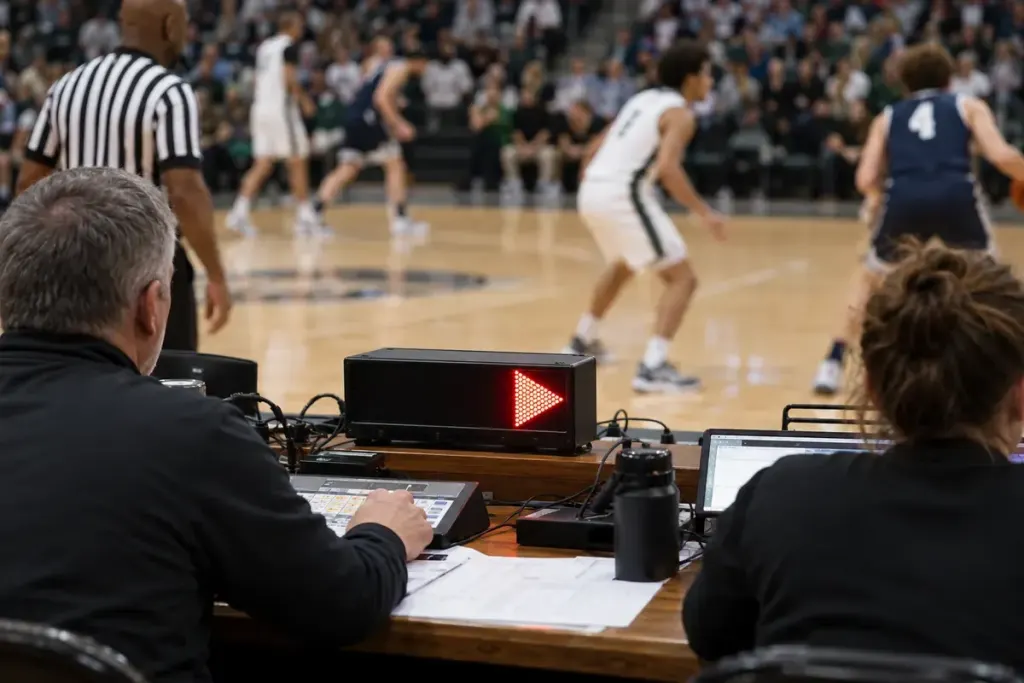
The game begins with a jump ball. Later, two opponents hold the ball firmly and the referee signals a held ball, but there is no new jump at centre court. In FIBA basketball, alternating possession provides the restart for these jump-ball situations.
Article 12 of the FIBA Official Basketball Rules 2026, available through Basketbal Vlaanderen, sets out the procedure. The team that does not gain the first team control after the opening jump receives the first alternating-possession entitlement. This explanation concerns FIBA rules; other competitions may use different procedures.
The arrow records the next entitlement
The arrow indicates the direction of the opponents’ basket for the team entitled to the next alternating-possession throw-in. It is not a live indicator of which team currently has the ball during ordinary play.
When an alternating-possession throw-in ends, the arrow reverses. A team’s violation during its own alternating-possession throw-in also costs that entitlement. A foul during the throw-in does not, by itself, cause the entitled team to lose it.
The arrow is also relevant to starting later quarters and overtimes, subject to any penalties that still need administration. A routine basket, steal or out-of-bounds possession does not automatically flip it.
Watch one sequence at the next game
- Notice which team gains the first control after the opening jump.
- Identify the team entitled to the first alternating-possession throw-in.
- Watch the next held-ball situation and the referee’s direction.
- Observe the arrow after the resulting throw-in ends.
This viewing exercise makes the table equipment easier to understand without trying to memorise every exceptional case. If you are serving as a table official, use the current official rules, interpretations and training for the competition rather than this introductory summary alone.
Once the distinction between current possession and the next alternating entitlement is clear, the arrow stops looking like an unexplained extra scoreboard light.