
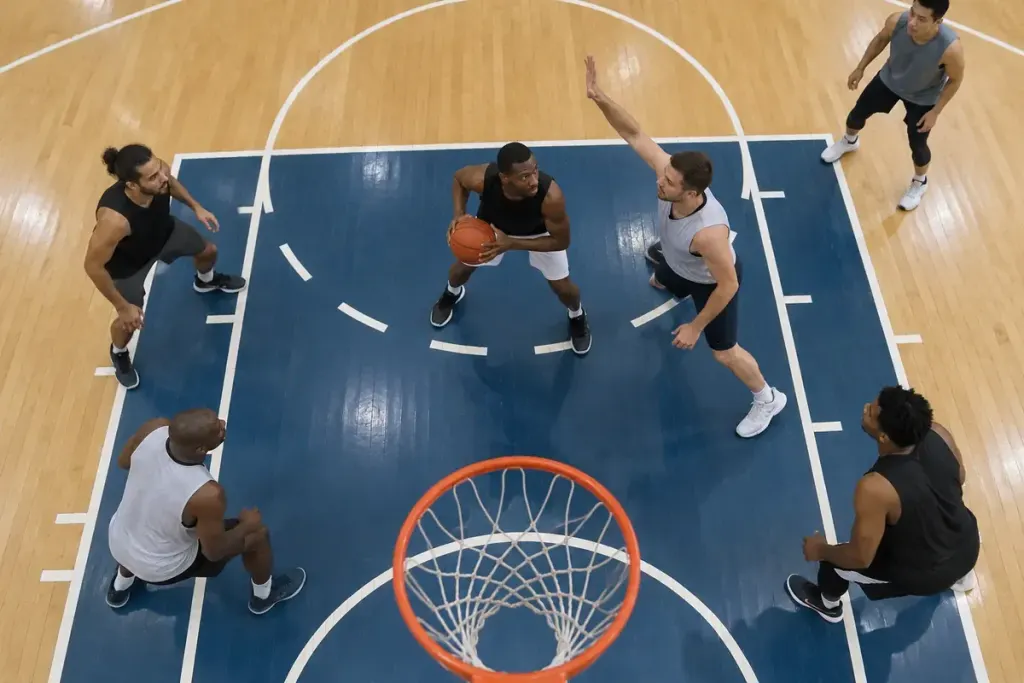
A player stands near the basket and spectators begin counting. Position matters, but the offensive three-second rule also depends on possession and the game clock. A still image cannot show all of those conditions.
The FIBA 2024 Official Basketball Rules Interpretations, Article 26 describes remaining in the opponents’ restricted area for more than three consecutive seconds while the team controls a live ball in its frontcourt and the game clock is running. This article explains that published FIBA framework; check the edition and ruleset used by the competition you are watching.
Follow the possession as well as the player
The interpretations give a useful contrast: during a frontcourt throw-in, a teammate may be in the restricted area while the clock has not yet started. That is not the same situation as live frontcourt play with the clock running.
For an original viewing exercise, watch a short possession twice. First track the offensive player in the lane. Then watch when the team gains control and what happens to the clock. Combining those observations gives a better starting point than counting whenever a shoe appears in the painted area.
Do not confuse this with an NBA defensive three-second rule or with a different competition’s local provisions. Similar names can describe different restrictions. The applicable rulebook and its exceptions need to be read together.
If you are keeping match notes, describe the conditions rather than writing only “three seconds missed.” Note which team controlled the ball, whether play was running, and where the player remained. Video perspective can still make a boundary or timing difficult to judge.
The rule becomes easier to understand when the count is attached to the game state. The painted area is part of the explanation, but it is not the entire explanation.