
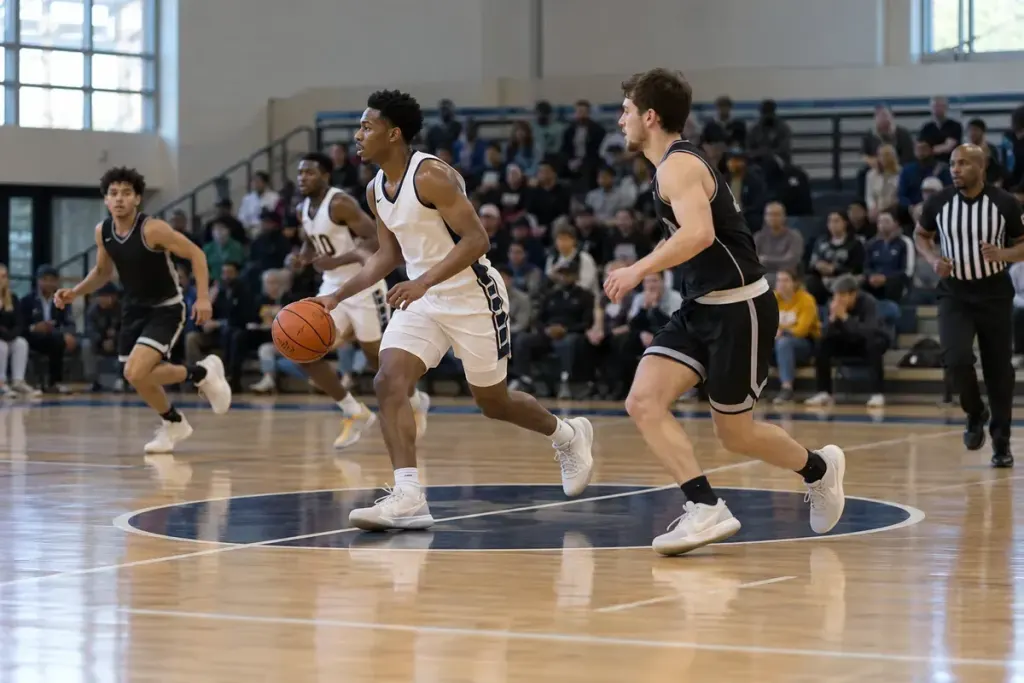
The ball crosses the centre line and somebody immediately calls a backcourt violation. The line matters, but it does not tell the whole story. Under FIBA rules, the decision also depends on control and the sequence of touches that returned the ball.
FIBA’s published backcourt case analysis explains the rule through a specific play: a team controlling a live ball in its frontcourt, its player last touching there, and the team’s subsequent first touch after the return. Use the official rules and interpretations applicable to the competition for the full conditions and exceptions.
Reconstruct the possession
When reviewing a clip, pause before the apparent violation. Establish whether the attacking team had frontcourt control. Then follow the last touch before the ball returned and the first relevant touch afterwards. A defensive deflection can change the sequence you need to assess.
Do not assume that a defender touching the ball always means the defender gained control. Touch and control are different concepts. Equally, a ball merely travelling through the air above one half of the court does not answer every question about a player’s location or status.
Use a complete example in practice
For a team discussion, choose an official example and replay it slowly. Ask players to describe the sequence before giving the ruling. This develops a more useful habit than memorising “never pass backwards”, which oversimplifies situations involving throw-ins, deflections and changes of control.
Keep the ruleset explicit. A local league may use rules or modifications different from the competition in the video. Referees also need the full play, not a cropped image of the ball near the line.
The best question is not simply where the ball went. It is which team controlled it, who touched it and when those events occurred.