
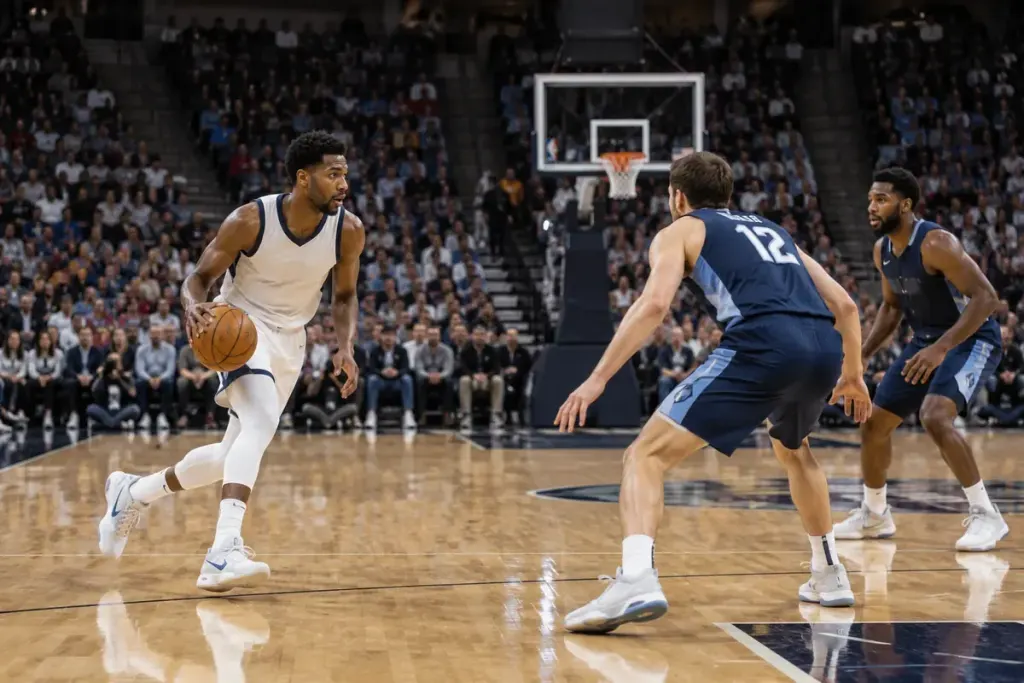
A team still has time on the shot clock, yet the referee stops play before the ball reaches the attacking half. That can be an eight-second violation rather than a shot-clock violation. The two restrictions concern different parts of a possession.
Under NBA Rule 10, Section VIII, a team may not keep continuous possession of the ball in its backcourt beyond eight consecutive seconds, subject to the rule’s stated exceptions. The penalty is loss of possession. This article uses the NBA rules as its example; other competitions should be checked against their own rulebook.
Advancing is different from attempting a shot
The NBA’s shot-clock rule governs the time available to attempt a qualifying field goal and describes when that clock starts, stops and resets. Reaching the frontcourt does not by itself give the attacking team a new full shot clock.
In a simple uninterrupted possession, the team therefore has an earlier task: advance the ball legally. Once that task is complete, it still has to organise an attack within the remaining shot-clock time. These are related deadlines, not two names for the same violation.
Watch the sequence rather than one screenshot
When reviewing a play, identify when possession began, whether play was interrupted and which rule applies to any restart. A television image showing a clock at one instant may not reveal the whole sequence. Do not assume every whistle or deflection creates a fresh eight-second period.
For a viewing exercise, follow one ordinary possession from the backcourt into the frontcourt and then to a shot. Notice the defender’s pressure and the attacker’s passing options. You can understand why the offence is hurried without trying to adjudicate a close call from an incomplete replay.
For coaching or officiating, use the current competition rules and official interpretations. The useful distinction for a new viewer is that getting into the attacking half and completing a shot attempt have separate timing requirements.