
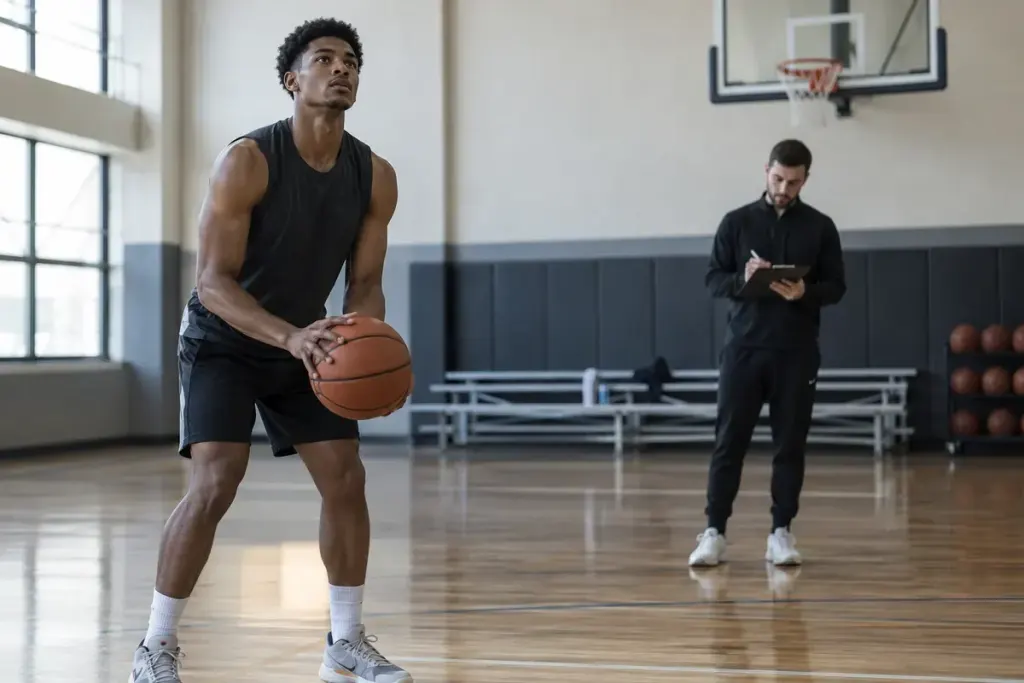
Making six of ten free throws tells you the result of a short set. It does not tell you whether the four misses were mostly short, scattered in several directions, or produced after a change in routine. A small extra note can make the next practice conversation more useful.
Use a simple record that does not interrupt every attempt. A partner can mark makes and broad miss directions, or you can note the pattern after a short set. Keep the categories easy to recognise rather than pretending you can measure an exact angle from the sideline.
Describe before diagnosing
“Three misses were short” is an observation. “My legs are definitely the problem” is an interpretation that needs more evidence. Several factors can produce a similar result, and a coach may need to see the full movement rather than infer it from the ball’s landing place.
Record relevant context such as fatigue, a different ball, or a new routine. These details help distinguish a recurring pattern from an unusual set. Do not turn every missed shot into a technical correction; constant changes can make the session harder to interpret.
Compare similar practice conditions
Keep some sets comparable across sessions. If one record comes from relaxed shooting and another from a demanding drill, label the difference. Both may be useful, but they answer different questions about performance.
Review a sequence of sessions rather than celebrating or worrying over one small sample. Bring a persistent pattern to a qualified coach, along with the notes. The record should support observation and feedback, not replace it.
Finish with one clear focus agreed for the next session. It might concern a consistent pre-shot routine or another element the coach has identified. A percentage tells you what happened; a careful pattern note helps you ask a better question about what to practise next.